
DISCLAIMER
The draft recommendations contained herein were preliminary drafts submitted for discussion purposes only and do not constitute final determinations. They have been subject to modification, substitution, or rejection and may not reflect the adopted positions of IFATCA. For the most current version of all official policies, including the identification of any documents that have been superseded or amended, please refer to the IFATCA Technical and Professional Manual (TPM).
65TH ANNUAL CONFERENCE, Bucharest, Romania, 20-24 April 2026
WP No. 160
ATCOS and ATM Facilities in Conflict Zones
Presented by PLC
| SUMMARY Armed conflicts increasingly threaten Air Traffic Controllers (ATCOs) and the critical Air Traffic Management Facilities they rely upon. Recent attacks in Yemen, the Democratic Republic of Congo, Iraq, Israel, Libya, Sudan, Syria, and Ukraine highlight the dangers faced by ATCOs in conflict zones. These attacks not only disrupt global air transport, leading to rerouted flights and increased workload, but also endanger the lives of ATCOs. This paper examines the legal position and status of civilian ATCOs under International Humanitarian Law (IHL). While Article 51 of the Geneva Conventions grants civilian ATCOs protected status, the “Military Objective” test under Article 52 creates a dangerous ambiguity. In modern warfare, civilian ATC facilities are increasingly categorized as military targets by belligerents, placing ATCOs at risk of being collateral damage. |
Introduction
1.1. The world population has grown accustomed to air travel, and growth trajectories have shown unprecedented increases since the end of the Second World War. The International Civil Aviation Organisation (ICAO), through its strategic masterplan document, the Global Air Navigation Plan, GANP (Doc 9750), has predicted the doubling of traffic every 15 years. Air Traffic Control Officers (ATCOS) play a critical role in ensuring that the airspace is safely and efficiently managed to accommodate this growth.
1.2. Armed Conflicts have occurred and continue to occur across the world. The consequences of these conflicts are reflected in human, economic, social, and environmental costs.
1.3. During armed conflicts, civilians and civilian infrastructure that facilitates the sustenance of life may be affected. The provision of ATC Services to facilitate air transport may be disrupted in the areas of conflict. This necessitates the activation of contingency arrangements, which often results in increased traffic workload over adjacent airspaces.
1.4. ATCOs, the critical professionals whose expertise ensures the sustained management of the intricate and complex global air traffic network, have often been caught in the milieu of armed conflicts.
1.5. Two Member Association (MA) States (Congo DR and Yemen) have recently had the misfortune of having their ATCOs being caught up in attacks at airports while they were providing Air Traffic Control Service. In May 2025, a missile attack targeting Ben Gurion Airport, in Tel-Aviv, Israel, was reported, fortunately no ATCO was physically harmed. Since 2000, there have been six reported violent attacks that have directly affected Air Traffic Control facilities.
1.6. This paper explores the vulnerabilities of ATCOs in conflict areas, the status of their protection under International Humanitarian Laws and the complexities surrounding the status of an airport and Air Traffic Management (ATM) facilities as military objectives.
Discussion
2.1. Conflict Zones
2.1.1. Conflict Zones are defined by ICAO in DOC 10084 (Risk Assessment Manual for Civil Aircraft Operations Over or Near Conflict Zones) as “areas where conflict is occurring or is likely to occur between militarized parties, which may include both State and Non-State actors. It also includes areas where such parties are in a heightened state of tension”.
2.1.2. Doc 10084 contains advice to States, aircraft operators (civil and military), air navigation services providers (ANSPs), and other entities deemed appropriate on the subject of risk management for civil aircraft operations over or near conflict zones. It contains consolidated guidance to support the implementation of relevant International Civil Aviation Organization (ICAO) Standards and Recommended Practices (SARPs), ICAO guidance material and industry best practices. It covers the risk from both deliberate acts and unintentional hazards to civil aircraft operations over or near conflict zones.
2.2. International Law
2.2.1. The United Nations defines international law as “the law governing relations between States”. International law sets up a framework based on States as the principal actors in the international legal system. It defines the States’ legal responsibilities in their conduct with each other, within State’s boundaries, and in their treatment of individuals. International law encompasses many areas, including human rights, disarmament, transnational organized crime, refugees, migration, statelessness, the treatment of prisoners, the use of force, the conduct of war, the environment, sustainable development, the oceans, outer space, global communications, and world trade.
2.2.2. To become party to a treaty, a State must express, through a concrete act, its willingness to undertake the legal rights and obligations contained in the treaty. The State must “consent to be bound” by the treaty.
2.2.3. A State can express its consent to be bound by a treaty in several ways, as specifically set out in the final clauses of the relevant treaty. The most common ways are:
a. definitive signature;
b. ratification;
c. acceptance;
d. approval;
e. accession.
2.2.4. The above terms mean the same thing in international law and indicate that a State has agreed to become a party and is willing to undertake the legal rights and obligations contained in the treaty upon its entry into force.
2.3. Challenges in the Enforcement of International Laws
2.3.1. There is no overarching compulsory judicial system or coercive penal system to address breaches of the provisions set out in treaties or to settle disputes. The lack of compliance and enforcement mechanisms often hinders the effectiveness of international law. Unlike domestic law, which is backed by the power of the state, international law relies largely on voluntary compliance by states. As a result, states often flout their international legal obligations with impunity, undermining the credibility and effectiveness of the international legal system.
2.3.2. The International Court of Justice (ICJ) is the principal judicial organ of the United Nations (UN). It settles legal disputes submitted to it by states and provides advisory opinions on legal questions referred to it by other UN organs and specialized agencies. The ICJ adjudicates general disputes between countries, with its rulings and opinions serving as primary sources of international law. While its judgments are binding on the parties and final, the ICJ possesses no formal enforcement mechanism. Enforcement of its rulings is ultimately a political matter for the UN Security Council, where it is subject to the veto power of the five permanent members.
2.4. International Humanitarian Law (IHL)
2.4.1. IHL is a set of rules that seek, for humanitarian reasons, to limit the effects of armed conflict. It protects individuals who are not or are no longer participating in the hostilities and restricts the means and methods of warfare. IHL applies to armed conflicts and protects those who do not participate in the fighting, such as civilians, medical and religious military personnel. It also protects those who have ceased to take part, such as wounded, shipwrecked, and sick combatants and prisoners of war.
2.4.2. IHL prohibits all means and methods of warfare which:
a. fail to discriminate between those taking part in the fighting and those, such as civilians, who are not, the purpose being to protect the civilian population, individual civilians and civilian property;
b. cause superfluous injury or unnecessary suffering; and
c. cause severe or long-term damage to the environment.
2.5. The Geneva Conventions
2.5.1. IHL has two branches: the ‘Law of Geneva’, which is the body of rules that protects victims of armed conflict, such as military personnel who are hors de combat (out of combat due to sickness, wound or capture) and civilians who are not or are no longer directly participating in hostilities. The second is the ‘Law of The Hague’, which is the body of rules establishing the rights and obligations of belligerents in the conduct of hostilities, and which limits means and methods of warfare.
2.5.2. The Geneva Conventions are a series of four international agreements that form the core of IHL, establishing legal standards for the treatment of non-combatants in war. The Fourth Geneva Convention addresses the treatment of civilians during armed conflict.
2.6. Civilian and Civilian Populations
2.6.1. The basic rule that ensures the respect for and protection of civilian population and civilian objects is detailed in Article 48 of the Protocol Additional to the Geneva Convention. It states that the parties to the conflict shall at all times distinguish between the civilian population and combatants and between civilian objects and military objectives and accordingly shall direct their operations only against military objectives.
2.6.2. In an international armed conflict, Article 50 of the Protocol Additional to the Geneva Conventions defines a civilian as: any person who does not belong to the armed forces. In case of doubt, a person must be considered a civilian. In a non-international armed conflict, all persons who are neither members of state armed forces nor members of an organized armed group are considered civilians.
2.6.3. The civilian population is made up of civilian persons. In international armed conflicts, the presence within the civilian population of individuals who do not come within the definition of civilians does not deprive the population of its civilian character. Appropriate rules protect the whole population of a party to a conflict without any adverse distinction. Both in international and non-international armed conflicts, the civilian population enjoys general protection against the dangers of military operations.
2.7. Protective Status of ATCOs During Conflicts
2.7.1. It can be deduced from the IHL definition, an ATCO who is not a member of the armed forces can be termed a civilian.
2.7.2. Article 51 of the Protocol Additional to the Geneva Conventions provided protective status to the civilian population and individual civilians, who shall not be the object of attack. Civilian ATCOs, therefore, are entitled to protective status under Article 51 and should not be deliberately targeted during armed conflicts.
2.8. Protective Status of Civilian Objects
2.8.1. Article 52 of the Additional Protocol to the Geneva Convention states that civilian objects shall not be the object of attack or of reprisals. Civilian objects are all objects that are not military objectives.
2.8.2. Military objectives are defined under IHL as those objects:
a. which, by their nature, location, purpose, or use, make an effective contribution to military action; and
b. whose total or partial destruction, capture, or neutralization, in the circumstances ruling at the time, offer a definite military advantage.
2.8.3. However, Article 52 further explains that in case of doubt as to whether an object is used for a military purpose, it shall be presumed not to be used.
2.8.4. The definition is so fluid and may be subject to the interpretation of a belligerent armed party, intending to gain a military advantage. For example, an adversary may consider an airport or an air traffic control facility as a military objective if it would provide a military advantage by the nature of its location, purpose, or use.
2.8.5. This situation makes the ATCO vulnerable, especially those operating in conflict zones with heightened military or armed group activities.
2.9. Status of Civil, Joint User, and Military Aerodromes
2.9.1. Civil aerodromes serve public, commercial, and private aviation, while military airfields are dedicated to defense operations and strategic purposes. Joint-use aerodromes combine both, with infrastructure shared by military and civilian operators.
2.9.2. It can be deduced from the above classification that there is no ambiguity as to the military objective status of both military and joint user aerodromes. However, an attack on a civil aerodrome may be considered a violation of IHL. This also applies to ATC facilities (Control tower, ACCs, etc) located in either Civil, military, or joint user aerodromes.
2.9.3. A civilian ATC facility located in a purely civilian location may still be considered a military objective if it makes “an effective contribution to military action”. A civilian ATCO working in such a facility may be caught up in such unfortunate circumstances.
2.10. Network disruptions during periods of conflict
2.10.1. During violent armed conflict the provision of ATC Services to facilitate air transport in the affected and adjacent areas of the conflict is frequently disrupted. This often necessitates the activation of contingency arrangements, including rerouting traffic or the transfer of control, which results in increased traffic complexity and workload in adjacent airspaces.
2.10.2. For instance, the conflict in Ukraine, particularly the airspace closures, resulted in increased air traffic volumes over some areas of Europe as airlines have been forced to reroute their flights, leading to congestion and longer flight times. Similarly, conflicts in Libya, Niger and Sudan have also led to the re-routing of flights with longer trajectories. ATCOs working on adjacent sectors, receiving the rerouted air traffic, experienced an increased workload as a result of an unprecedented increase in traffic volumes.
2.11. Armed Conflicts and Safety of ATCOs: Some Examples
2.11.1.Air Strike on Sanaa’s Control Tower (Yemen)
A devastating airstrike was carried out on the Sana’a International Airport on 26th December 2024, destroying the tower cab and injuring two air traffic controllers. Despite the destruction and imminent danger, the injured controllers at Sana’a Control Tower demonstrated remarkable bravery by continuing to provide essential air traffic control services to an arriving aircraft. Their commitment underscores the vital role air traffic controllers play in ensuring the safety of the flying public and the integrity of aviation operations, even amidst crises.
IFATCA issued a strong statement condemning the airstrike and expressing solidarity with Yemen ATCOs. The Federation equally called for respect for international protocols, including ICAO’s Annex 17, UN Security Council Resolution 2286, and Article 52 of Additional Protocol I to the Geneva Conventions, which mandates the protection of civilian personnel and infrastructure critical to public safety.
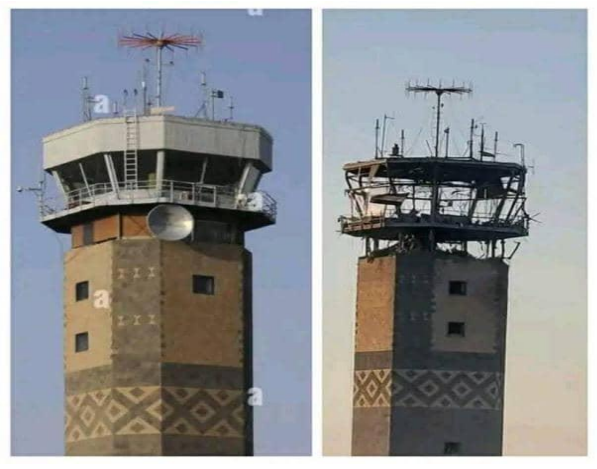
Fig.1 Sana’a Control Tower before and after an airstrike (Source: Getty Images)
2.11.2. Goma Airport Attack (Congo Democratic Republic)
Goma International Airport in the Congo Democratic Republic was attacked and subsequently captured by rebels on January 28, 2025, during their offensive on the city of Goma. (Reuters)
The control tower was vandalised. Fortunately, the ATCOs escaped due to the presence of the United Nations (UN) Mission at the airport. This led to the suspension of operations, which equally escalated humanitarian needs.
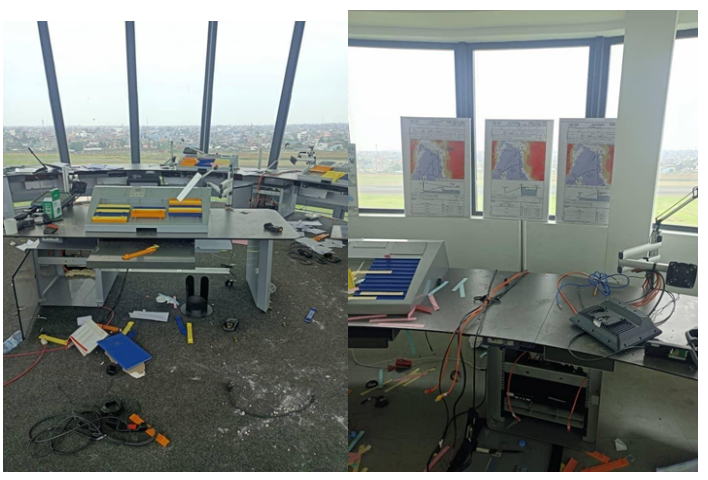
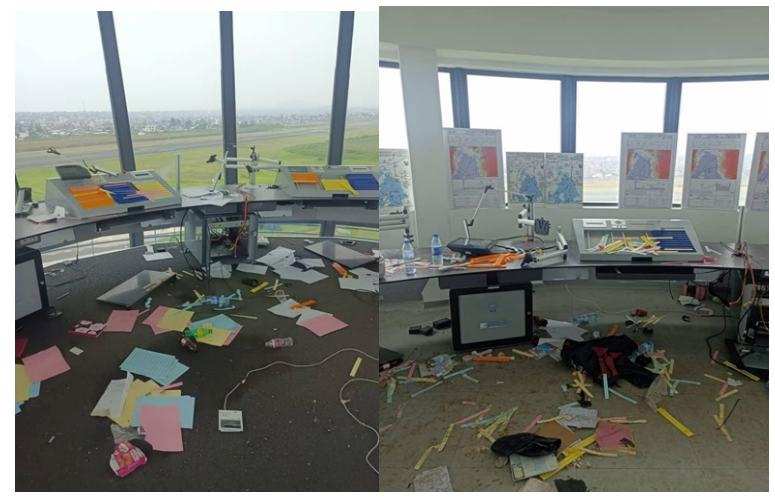
Fig. 2: Vandalised Goma Control Tower (Source: Facebook)
2.12. The Military Objective Test Dilemma
2.12.1.A perspective to consider is that if an ATCO is working in a civilian aerodrome, they could still be at risk, not because they are a civilian ATCO, which status should afford them protection under Article 51 of the Additional Protocols to the Geneva conventions, but that the civilian facility they work in could meet the definition of ‘military objective’.
2.12.2. Unfortunately, the practicality of protecting a civilian ATCO working in a civil facility in a high-risk conflict zone is highly improbable, as this is dependent on the definition of what constitutes a military objective by the belligerent party. This also by no means takes the responsibility from the belligerent party not to take measures, as prescribed in IHL, that;
a. fail to discriminate between those taking part in the fighting and those, such as civilians, who are not, the purpose being to protect the civilian population, individual civilians, and civilian property; and
b. cause superfluous injury or unnecessary suffering.
2.13. IFATCA policy
2.13.1. IFATCA, being an apolitical Federation of air traffic controllers’ associations, has one of its primary objectives to protect and safeguard the interests of the air traffic control profession.
2.13.2. IFATCA recognises the significance of crisis management and notes the global and regional initiatives to help the aviation industry cope with major disruptions.
2.13.3. IFATCA produced the Crisis Response and Communications Planning Guide (Tanzania, 2008) to help Member Associations (MAs) dealing with events that could be categorized as a crisis. This guide calls for ANSP’s to have contingency plans. At the Tanzania 2008 Conference, the IFATCA Executive Board presented the Crisis Response and Communications Planning Guide as a guideline for the Member Associations to help in the process of preparing for, and dealing with events which could be categorized as a crisis, or which could evolve into a crisis.
2.13.4. According to the IFATCA Crisis Guide: A crisis is any event or situation that could:
a. hinder the ability of an air traffic control unit to operate effectively, or
b. damage the reputation of an air traffic control unit (or Service Provider) with stakeholders, users, and the public, all of whose support is essential for successful operations. (Sofia 2015)
2.13.5. The definition has a broader scope that would encompass armed conflict, which affects ATCOs, as shown in the examples in Congo DR and Yemen.
2.13.6. IFATCA further came up with a policy on Crisis Management in Sofia 2015, to further buttress the need for involvement of air traffic controllers in the development of contingency and crisis management plans.
2.13.7. IFATCA Policy ATS 3.39 CRISIS MANAGEMENT
IFATCA Policy is:
Air traffic controllers should be involved in the development of contingency and crisis management plans. This includes regional and sub-regional contingency plans. IFATCA supports the OCIR model for the development of such procedures. Contingency plans should be regularly updated.
2.13.8. The effect of attacks on a facility or location in a conflict zone where an ATCO could be a victim is certainly a crisis that is capable of disrupting the provision of air traffic control services.
2.13.9.A key aspect to note of an armed attack is the element of surprise that is deployed. Under such circumstances, the effects may be devastating, and ATCOs may turn out to be unfortunate victims.
2.14. ICAO Provisions
2.14.1. ICAO in Annex 11 (2.32) requires Air traffic services authorities to develop and promulgate contingency plans for implementation in the event of disruption, or potential disruption, of air traffic services and related supporting services in the airspace for which they are responsible for the provision of such services. Such contingency plans shall be developed with the assistance of ICAO as necessary, in close coordination with the air traffic services authorities responsible for the provision of services in adjacent portions of airspace and with airspace users concerned. This approach requires coordination and participation by stakeholders.
2.14.2. ICAO Doc 10084 advises States, aircraft operators (civil and military), air navigation services providers (ANSPs) and other entities deemed appropriate on the subject of risk management for civil aircraft operations over or near conflict zones. It covers the risk from both deliberate acts and unintentional hazards to civil aircraft operations over or near conflict zones and outlines the responsibilities of Regulatory Authorities, Operators, and Air Navigation Service Providers (ANSPs).
2.15. Threat Risk Assessments for the Provision of Air Traffic Control at or Near Conflict Zones
2.15.1. ICAO’s focus in Doc 10084 is on the risk to civil aircraft operations near conflict zones. The pertinent concern for the ATCOs, going by the events that have directly impacted them, as provided for in this paper (Yemen and Congo DR), is to have a holistic risk and threat assessment to enable decision-making for their safety and the continuity of service. This can be achieved by the collaboration of ATCOs and their ANSPs.
2.15.2. Like traditional aviation security risk assessment, a conflict zone risk assessment for ATC operations should be based on an evaluation of threat measured through likelihood, consequence, and vulnerability for each defined scenario. Once the risk value is obtained, recommendations for possible mitigations can be provided.
2.15.3. The possible difficulty that may be encountered is that the information regarding the intent and capability of state and non-state actors involved in a conflict may be difficult to gather for several reasons, including the fact that the information may be classified. However, means of getting information may have to be deployed to safeguard lives.
2.15.4. The current IFATCA TPM, while having a policy on Crisis Management, lacks guidance on the application of Threat and Risk Assessment (TRA) frameworks for areas affected by armed conflict. A TRA framework is a structured method for identifying, analysing and managing risks arising from threats to people, infrastructure or operations.
2.15.5. Consequently, IFATCA should consider expanding its crisis management framework to encourage MAs, in collaboration with their ANSPs, to conduct and implement comprehensive TRA in and adjacent to potential conflict zones.
2.16. Future Considerations
2.16.1. During the research and writing of this paper, it has become apparent that there are additional areas that may be relevant and require further exploration. These concepts include:
- The need for IFATCA to liaise with ICAO and advocate for the expansion of the scope of Doc 10084 to include the safety and protection of ATCOs and facilities in and near conflict zones, in addition to the operations of aircraft;
- MAs to negotiate with their ANSPs to ensure ATCOs have a “Neutrality and Safety Clause” that allows for the suspension of services without fear of reprisal when an armed threat is imminent.
- IFATCA and MAs consider providing ATCOs with basic training on their status under the Geneva Conventions to ensure they understand their rights as civilians.
- ATCOs should be encouraged to maintain a personal Dynamic Risk Assessment (DRA) when operating in conflict zones.
- Civilian ATCOs should not be required to provide ATC services to military combat operations if doing so compromises their protected civilian status under the Geneva Conventions.
- Civilian ATCOs who have provided service during active armed conflict or survived attacks on their facilities must be provided with immediate Critical Incident Stress Management (CISM) and specialized psychological support.
- MAs should ensure that Duty of Care protocols include long-term health monitoring for Post-Traumatic Stress Disorder (PTSD) and the right to facility relocation without loss of professional standing.
Conclusion
3.1. ATCOs provide safety critical services that facilitate the movement of billions of passengers and tons of cargo through an air traffic network. The operational safety risk over and around conflict zones affects not only aircraft operations but may also affect ATCOs, as illustrated in this paper.
3.2. Airports, historically, have been targeted as military objectives that provide military advantage to belligerents during armed conflicts. Civilian ATCOs, though protected under IHL, may be unfortunate victims of armed conflicts.
3.3. As escalating global conflicts and the proliferation of sophisticated weaponry heighten the threat to civilian aviation, the risks faced by ATCOs continue to mount. The reality of modern warfare, marked by high-tech weaponry and shifting frontlines, places ATCOs and ATM facilities in unprecedented danger.
Recommendations
4.1. It is recommended that:
Further study needs to be done on this subject, and it should be added to the PLC work program for the upcoming year.
4.2. It is recommended that:
IFATCA updates the Crisis Management policy to include a requirement for proactive TRA, specifically for conflict zones;
| ATS 3.39 CRISIS MANAGEMENT |
IFATCA Policy is: Air traffic controllers should be involved in the development of contingency and crisis management plans. This includes regional and sub-regional contingency plans. IFATCA supports the OCIR model for the development of such procedures. Contingency plans should be regularly updated. MAs, whose States are located within or near conflict zones, should in formal collaboration with their ANSPs and other stakeholders, conduct comprehensive Threat Risk Assessments (TRA) to support informed decisions on service continuity and personnel safety. |
4.3. It is recommended that the following statement be considered for inclusion in TPM as a provisional policy:
| ATS x.xx – PROTECTION OF ATCOS IN CONFLICT ZONES |
Proposal: When ATCOs are required to operate in facilities that may be considered a ‘military objective’ under International Humanitarian Law, they must be fully apprised of the associated risks and appropriate mitigation measures put in place, prioritising the protection of ATCOs, which may include relocation or the evacuation of the facilities when risk thresholds are exceeded. |
References
5.1. Associated Press; Retrieved from https://apnews.com/article/un-yemen-airportisrael-airstrikes-who-humanitarian
5.2. Assembly — 42nd Session Report of the Executive Committee on Agenda Item 13
5.3. Aviation’s War & Conflict Risks: Analysis & Mitigation; Retrieved from https://www.datainsightsmarket.com/news/article/aviations-war-conflict-risksanalysis-mitigation-59654
5.4. Classification of Armed Conflict; Retrieved from https://www.rulac.org/classification
5.5. Chen Chu et.al, 2024; Assessing impacts of the Russia-Ukraine conflict on global air transportation: From the view of mass flight trajectories, Journal of Air transport Management
5.6. Geneva Conventions, (1949); Relative to The Protection of Civilian Persons in Time of War
5.7. Geneva Convention, (1977); Protocol Additional to the Geneva Conventions of 12 August 1949, and relating to the Protection of Victims of International Armed Conflicts (Protocol I)
5.8. Global Fleet and MRO Market Forecast 2025-2035: Retrieved from https://www.oliverwyman.com/our-expertise/insights/2025/
5.9. ICAO Doc 9750, Global Air Navigation Plan
5.10. ICAO Annex 11, Air Traffic Services
5.11. ICAO (2022) Annex 17, Aviation Security Twelfth Edition
5.12. ICAO (2013) Doc 9985, Air Traffic Management Security Manual
5.13. ICAO Doc 10084 Risk Assessment Manual for Civil Aircraft Operations Over or Near Conflict Zones
5.14. ICRC (2004); Advisory Service on International Humanitarian Law, Retrieved from https://www.icrc.org/sites/default/files/document/file_list/what-is-ihl-factsheet.pdf
5.15. ICRC (2008); How is the Term “Armed Conflict” Defined in International Humanitarian Law? Retrieved from https://www.icrc.org/sites/default/files/external/doc/en/assets/files/other/opinionpaper-armed-conflict.pdf
5.16. IFATCA (2024) Press Release, Retrieved from https://ifatca.org/ifatca-calls-forimmediate-action-to-protect-yemen-air-traffic-controllers/
5.17. IFATCA 54th ANNUAL CONFERENCE Sofia, Bulgaria 2015 WP 93 “Crisis Management.”
5.18. IFATCA, February 2008; “Crisis Response and Communications Planning Guide”
5.19. (2015) International Committee of the Red Cross (2015) INTERNATIONAL HUMANITARIAN LAW: ANSWERS TO YOUR QUESTIONS
5.20. Protection in armed conflict: Retrieved from https://emergency.unhcr.org/protection/protection-mechanisms/protectionarmed-conflict#
5.21. Protection of Civilians: Retrieved from https://www.unocha.org/protection-civilians#
5.22. Understanding International Law: Retrieved from https://treaties.un.org/doc/source/events/2011/press_kit/fact_sheet_1_english.pdf


