
DISCLAIMER
The draft recommendations contained herein were preliminary drafts submitted for discussion purposes only and do not constitute final determinations. They have been subject to modification, substitution, or rejection and may not reflect the adopted positions of IFATCA. For the most current version of all official policies, including the identification of any documents that have been superseded or amended, please refer to the IFATCA Technical and Professional Manual (TPM).
65TH ANNUAL CONFERENCE, Bucharest, Romania, 20-24 April 2026
WP No. 158
CO2 and Non-CO2 Trajectory Optimisation
Presented by PLC
| SUMMARY As global air traffic movements increase, placing pressure on a capacityconstrained Air Traffic Management system, what effects will the implementation of CO2 and non-CO2 trajectory optimisation have on Air Traffic Management? The objective of this paper is to: – determine the impacts of CO2 and non-CO2 trajectory optimisation on capacity, ATCO workload, and safety; – recommend any measures that will enable environmental trajectory optimisation. |
Introduction
1.1. Airport Council International (ACI) (2025) has reported that the estimated aircraft movement figures for 2024 are about 100 million. This represents a gain of 4.3% from 2023 and only 2.6% short of the numbers reached in 2019. Over the last 5 years there has been a large shift in the aviation industry towards achieving sustainable development. The focus is not only on the economic development of the industry but also on social and environmental aspects.
1.2. The International Civil Aviation Organisation (ICAO), in 2022, adopted a long-term aspirational goal (LTAG) of net-zero emissions from international aviation by 2050. The LTAG aligns with the United Nations Framework Convention on Climate Change (UNFCCC) and the Paris Agreement (COP21). The Paris Agreement wishes to see that CO2 emissions are reduced to limit global warming to 1.5 °C relative to the preindustrial age and an absolute limit set to keep global warming well-below 2.0 °C (ICAO, 2022a).
1.3. Trajectory optimisation may offer the aviation industry tangible benefits in reducing the industry’s environmental impact. This could be achieved through CO2 and/or nonCO2 trajectory optimisation which collectively can be classed as environmental trajectory optimisation or climate trajectory optimisation (Matthes et al., 2020; McEnteggart & Whidborne, 2012).
1.4. A critical issue to overcome in terms of trajectory optimisation will be Air Traffic Control Officer (ATCO) staffing. Eurocontrol (2022) reported that due to ATCO shortages and a lack of airspace capacity, en-route delays totaled 7.43 million minutes for 8.56 million flights in the European region. This highlights the fact that under the current operating paradigms, the aviation industry will not be able to achieve its environmental goals due to airspace constraints.
1.5. This paper aims to examine the effects of CO2 and non-CO2 trajectory optimisation on capacity, ATCO workload and safety and recommend any measures that could enable environmental trajectory optimisation.
Discussion
2.1. Trajectory Optimisation
2.1.1. The concept of trajectory optimisation is to improve one or more components of an aircraft’s flight trajectory. This will largely depend on the goals or KPIs that are being pursued by the operator and/or Air Navigation Service Provider (ANSP). These may be fuel savings, operational cost savings, environmental impact, airspace efficiency, noise abatement or safety (Rosenow, 2019).
2.2. 4D Trajectory Optimisation
2.2.1. 4D trajectory optimisation is a subset of trajectory optimisation whereby a trajectory is flown that aligns with the operator’s goals within a free route airspace (FRA) and is managed to achieve an optimal lateral (latitude/longitude), vertical and time profile (ICAO, n.d.).
2.3. Trajectory-Based Operations (TBO)
2.3.1. ICAO (2022b) defines trajectory-based operations (TBO) as:
“an air traffic management (ATM) environment where the flight trajectory of an aircraft is flown as close as possible to the user-preferred route, with as little disruptions as possible through collaborative decision-making mechanisms. This includes reducing potential conflicts and resolving demand/capacity imbalances earlier and more efficiently. TBO can therefore bring significant operational and environmental benefits to aviation.”
2.3.2. TBO requires a functional Air Traffic Flow Management (ATFM) system that can coordinate and collaborate with Airspace Users (AUs), Air Traffic Control (ATC) control sectors, Meteorological Service Providers, and Airspace Management (ASM) (ICAO, n.d.; ICAO, 2005).
2.3.3. TBO is a concept whereby aircraft will fly 4D trajectory optimised routes considering weather, airspace constraints within predetermined outcome-based goals. An outcome of TBO is that ATCOs move from tactical interventions to strategic oversight by managing conflicts on a longer-term time horizon. The goal of TBO is to reduce controller and pilot workload, while increasing the predictability, efficiency and capacity of airspaces (ICAO, n.d.).
2.4. Environmental Air Traffic Management (ATM) Trajectory Optimisation
2.4.1. The International Air Transport Association’s (IATA) (2025) strategy for improved operations and infrastructure could result in a reduction of 3% of the total CO2 emissions from aviation. They aim to achieve this through infrastructure improvements at airports and operational improvements in ATM. This figure differs from the viewpoint of Eurocontrol, who estimate that operational improvements are between 6 and 10% (IATA, 2025). These operational improvements will include trajectory optimisation strategies.
2.4.2. In terms of Environmental ATM Trajectory Optimisation, the outcomes being pursued will influence which greenhouse gas emissions are reduced. If the targeted greenhouse gas is CO2, then the trajectory optimisation will be focused on aircraft fuel efficiency and the resultant CO2 emissions – CO2 Trajectory Optimisation. NonCO2 Trajectory Optimisation focuses on reducing greenhouse gas emissions, NOx and H2O, excluding CO2. Contrail-forming emissions comprise the largest impact in the non-CO2 trajectory optimisation category (IFATCA, 2025).
2.4.3. Non-CO2 trajectory optimisation favours the reduction of climate warming effects caused mainly by persistent contrails, while CO2 trajectory optimisation favours the reduction of CO2 by reducing the overall fuel burn from aircraft across the entire network.
2.5. CO2 Trajectory Optimisation
2.5.1. As CO2 Trajectory optimisation aims to reduce CO2 by reducing aircraft fuel burn this can be achieved through improvements to lateral track efficiency as well as Continuous Descent Operations (CDO) and Continuous Climb Operations (CCO) for the vertical component.
2.5.2. Refer to ATS 3.25 CONTINUOUS DESCENT OPERATIONS (CDO) AND CONTINUOUS CLIMB OPERATIONS (CCO) https://ifatca.wiki/kb/tpm/ats/ats-3-25-continuous-descent-operations-cdo-and-continous-climb-operations-cco/
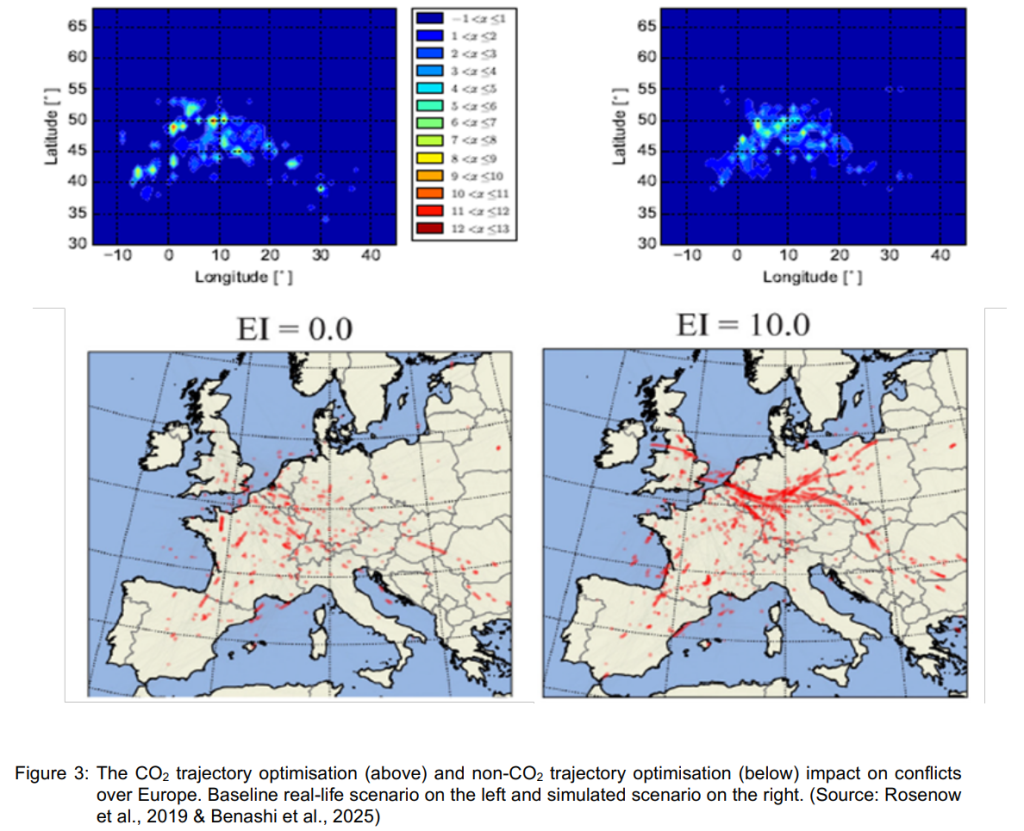
2.5.3. Rosenow et al. (2019) demonstrated through airspace models and simulations that free route trajectories over Europe have the capability to alleviate airspace congestion and reduce conflicts. Their simulation took actual flight data from a portion of European Airspace as a baseline; the same traffic loading was then simulated as a free route scenario. The results showed significant improvements in terms of reducing conflicts, fewer overloaded airspaces, improved utilisation of available airspaces, reduced distances of aircraft in conflict, reduced flight distances, reduced fuel burn, and a small reduction in the task-load of ATCOs. They did however find that sector complexity increased due to the free route trajectory optimised scenario.
2.5.4. The Performance Review Commission of EUROCONTROL (PRC) and the Performance Review Body of the Single European Sky (PRB) (2025), have found varied results in the assessment study on the performance benefits of free route airspace (FRA) implementation. FRA is an enabler for 4D trajectory optimisation enabling the users to fly their preferred trajectories within the FRA area (PRC & PRB, 2025). The report examines operational FRA implementation in the European Airspace. They engaged with stakeholders (Operators and ANSPs) to gain an understanding of their view of FRA, the benefits they observed, and the impacts on operations.
2.5.5. The PRC/PRB report found that there was a greater spread of traffic throughout the European FRA as aircraft were no longer required to fly on predefined route structures. Stakeholders were engaged with a questionnaire on FRA benefits and impacts on operations. Safety, conflicts, sector overloads, fuel burn, controller workload and sector capacity are of particular interest for this paper.
2.5.6. ANSP’s response to the impact of FRA on conflict creation and resolution shows 69% found a significant impact with almost half of those stating that conflicts were more difficult to identify. An additional comment from an ANSP stating that FRA implementation requires a trajectory-based ATS system and with controller tools to assist with conflict detection.
2.5.7. ANSP’s response to the impact of FRA on sector overloads shows that 20% found an increase in the number of sector overloads (instances where sectors were over capacity).
2.5.8. Airspace users’ response to the impact of FRA on planned and actual fuel burn shows that there was a significant reduction in planned fuel as well as a reduction in actual fuel burn, although to a lesser extent. There were no instances of an increase in planned fuel or actual fuel burn.
2.5.9. ANSP’s response to the impact of FRA on controller workload and sector capacity. 44% of ANSPs noted an observed increase in ATCO workload and 36% reported an increase in declared sector capacities.
2.6. Non-CO2 Trajectory Optimisation
2.6.1. Refer to IFATCA WP 159 Abu Dhabi 2025 https://ifatca.wiki/kb/workingpaper/2025/wp-2025-159/
2.6.2. Baneshi et al. (2025) recognise that climate related re-routing of aircraft has an impact on the ATM network with knock-on effects for the efficiency of the ATM system. Baneshi et al. (2025) investigated the possibility of using machine learning to plan routes in the European region that mitigate non-CO2 climate impacts, essentially providing a model that optimises the trajectory of aircraft in terms of non-CO2 climate
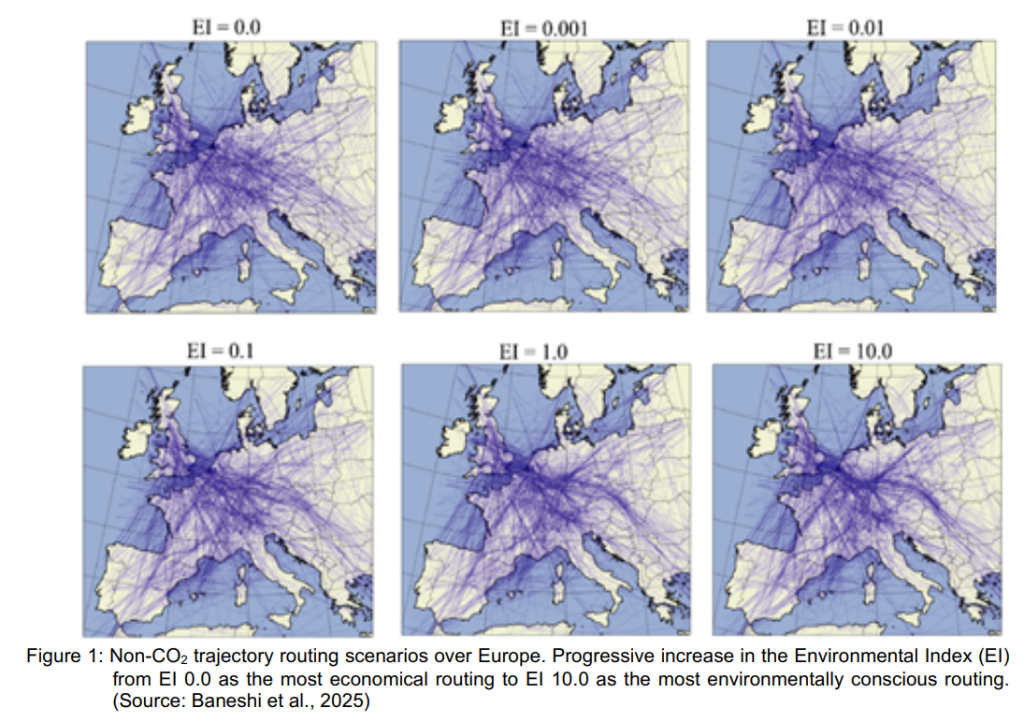
impacts. They utilised re-routing strategies in a lateral plane. Using this method, they were able to model the use of routing aircraft to areas that could favour the creation of cooling contrails while avoiding routing to areas that could result in warming contrails. The result of the model, when focusing on mitigating climate impacts, was that certain regions become increasingly more complex and potential aircraft conflicts increase, thus increasing the workload of ATCOs and increasing the risk of safety events (Fig 1) (Baneshi et al., 2025).
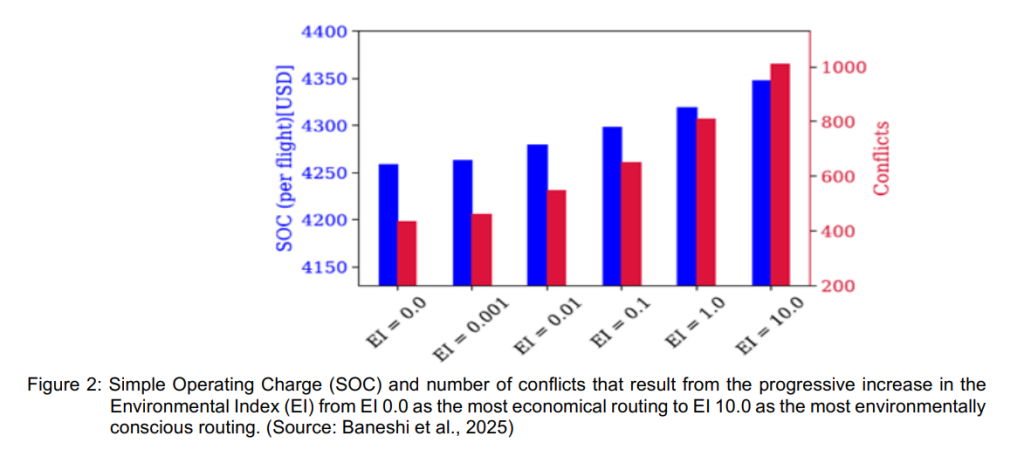
2.6.3. CO2 trajectory optimisation and non-CO2 trajectory are at odds with one another. Baneshi et al. (2025) show an increase in aircraft operating costs (due to increased fuel burn) as well as an increase in the number of conflicts as progressively more stringent non-CO2 routings are used (Fig 2 & Fig 3). When comparing CO2 trajectory optimisation and non-CO2 trajectory optimisation, CO2 trajectory optimisation option performs better in terms of reducing aircraft fuel burn and the resulting CO2 emissions. More data and research are required to determine which of these two strategies will best achieve a reduction in environmental impact (warming effect) from aviation.
2.7. Enabling measures to achieve Trajectory Optimisation
2.7.1. ATFM Demand and Capacity Balancing
2.7.1.1. The primary purpose of Air Traffic Flow Management (ATFM) is to ensure a safe, orderly and expeditious flow of air traffic by balancing demand and the available capacity of the ATM system (ICAO, 2018). Airspace is a finite resource and needs to be utilised in a fair and equitable manner for all airspace users. ATFM needs to achieve a balance between demand and available airspace capacity to enable a safe, efficient and orderly flow of traffic. ATFM operates over four interconnected stages: strategic, pre-tactical, tactical and post-operations analysis. Traffic flows need to be managed to ensure a smooth and efficient flow of traffic that does not cause overloading in any ATC sector. During this operation, various bottlenecks in the ATM and Airport Networks need to be identified. Continuous communication and collaboration between all ATC units as well as aircraft operators is required to achieve an effective ATFM outcome.
2.7.1.2. Having defined airspace or sector capacities is an important criterion for ATFM to achieve its objectives. It is important to note that although theoretical airspace capacity may increase due to improvements in airspace efficiency, as flights become more dispersed throughout an airspace or sector, this needs to be adjusted in line with the defined airspace sector capacities. Sector capacity is defined by IFATCA (2025b) as “The maximum number of flights which may enter a sector per hour averaged over a sustained period of time, to ensure a safe, orderly, and efficient flow of traffic”. Although there is no defined standard for sector capacity determination, sector capacity is commonly calculated with the following parameters: ATCO workload, size of the sector, up-stream and down-stream constraints, types of separation in force, aircraft type mix, and flight profiles in the sector (climbing, descending, cruise) (ICAO, 2025).
2.7.1.3. Refer to IFATCA WP 96, Study Air Traffic Flow Management https://ifatca.wiki/kb/working-paper/2011/wp-2011-96/
2.7.1.4. A working paper reviewing the IFATCA ATFM Policy will be presented by TOC/PLC at the IFATCA Annual Conference 2026.
2.7.1.5. It is concerning to note that in operational European FRA, 44% of the ANSPs responded to the PRC/PRB report questionnaire that ATCO workload had increased with 20% reporting that they experienced an increased frequency of sector overloads however sector capacity had increased for 36%. Only one ANSP had reported a capacity decrease due to FRA. These results seem incompatible as an increase in ATCO workload should result in a decrease in capacity. Considering 20% of the ANSPs reported an increased frequency of sector overloads and only one ANSP reported a decrease in capacity, it becomes questionable as to who calculated the capacity and/or how the capacity was calculated.
2.7.2. Interoperability
2.7.2.1. Interoperable ATM systems, refer to IFATCA WP 102 ATM Systems Interoperability https://ifatca.wiki/kb/working-paper/2025/atm-systemsinteroperability/
2.7.2.2. Refer to IFATCA WP 100, Global Harmonisation in the Interaction Between ATM Stakeholders in a TBO Mixed-Mode Operations https://ifatca.wiki/kb/workingpaper/2025/global-harmonisation-in-the-interaction-between-atm-stakeholders-in-atbo-mixed-mode-operations/
2.7.3. Airspace Design
2.7.3.1. 4D trajectory optimisation and TBO will require a paradigm shift in ATM, from the more traditional static airspace-based concept to a dynamic airspace concept that is adaptive to the needs of user preferred routes while considering other potential users of the airspace (Criscuolo et al., 2024; Gerdes et al., 2016).
2.7.3.2. Achieving this goal will require a substantial change in the layout of the current global airspace structure. This sentiment is echoed by Singh (2014), who states that the global airspace structure needs to change, and the number of control units needs to decrease by consolidating existing ANSPs and focusing on regional control units. He highlights that in 2014, there were about 160 Air Navigation Service Providers (ANSPs) across the globe, resulting in a fragmented global airspace. As of 2024, KPMG (Brown and O’Brien, 2024) reports that there has been no change to this number over the last 10 years.
2.7.3.3. IFATCA (2017) WP No. 84:
“The worldwide patchwork of FIRs and associated ANSPs is a cause of operational and organisational inefficiencies. In Europe, where the problem is most pronounced due to the large number of States and flights, functional airspace blocks (FABs) were envisaged as a solution; however, implementation has been slower than expected. Virtual centres provide a method of virtual, rather than physical, consolidation by isolating and geographically decoupling the data and control elements of ATM, which may provide an alternative path to achieve the aims of FABs. There remain a number of technical as well as professional and legal challenges to the virtual centre concept but its development continues. Along with space-based ADSB, virtual centres are an example of the increasing reliance that ANSPs are placing on third parties for communication, navigation and surveillance data.”
2.7.3.4. IFATCA has the following policies regarding the recommendation to consolidate airspace into larger regional control units.
2.7.3.5. IFATCA Policy ATS 3.7 ATC WITHIN ICAO ASSIGNED INTERNATIONAL AIRSPACE- THE IMPACT OF TECHNOLOGY
IFATCA Policy is:
The current ICAO assignment of international airspace within ICAO shall not be modified and/or changed based solely on the development and/or implementation of technology by one or more States, unless agreed to by all MAs concerned.
2.7.3.6. IFATCA Policy ATS 3.13 VIRTUAL CENTERS AND FUNCTIONAL AIRSPACE BLOCKS
IFATCA Policy is:
ATM data shall be of sufficient quality, reliability and integrity for its intended use.
Organisations that provide ATM services beyond state borders shall clearly define the operational and legal implications of providing these services, and train controllers in the implications.
The efficient creation and management of an FAB does not necessarily require the physical concentration of all ANS functions within a single centre.
Consideration shall be given to the personal and social implications for controllers associated with the relocation and/or consolidation of ATS units.
Consolidation of ATS units, whether virtual or physical, shall be considered equal to the implementation of a new ATM system.
2.7.3.7. IFATCA Policy AAS 1.8 4D Trajectory Concepts/ Management
IFATCA Policy is:
Implementation of 4D trajectory management requires appropriately designed airspace.
2.7.3.8. The provided sources lead to the conclusion that while global airspace consolidation is a necessary enabler for the evolution of 4D trajectory optimisation and TBO, the transition remains slow and fraught with complex challenges.
2.7.4. ATCO Staffing and workload
2.7.4.1. Eurocontrol (2022) shows that airspace capacity constraints are resulting in large amounts of delays over the European Region (Fig. 4). These delays are especially evident over the European summer months as traffic increases and adverse weather conditions become more disruptive to air traffic operations.
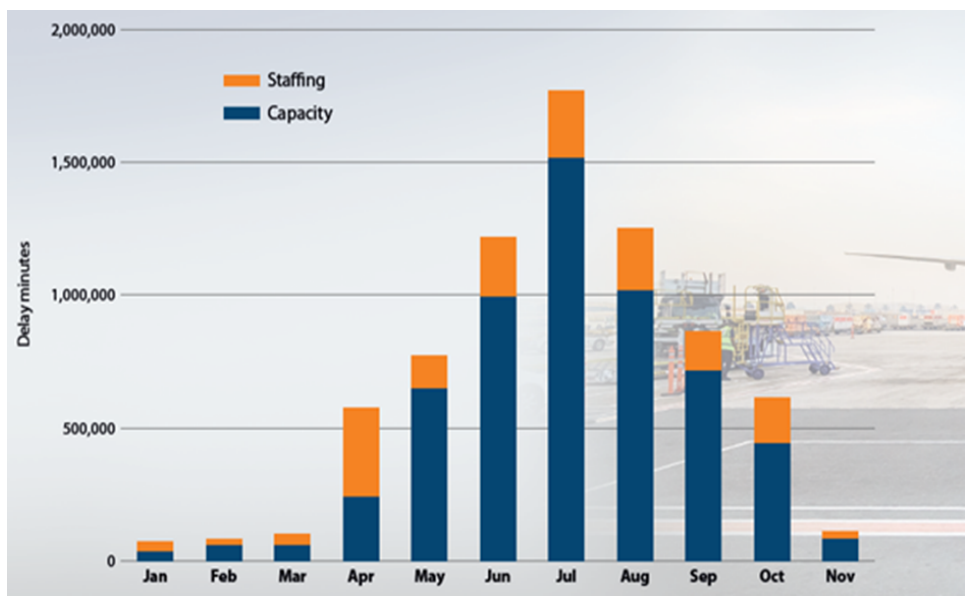
Figure 4: Air traffic control capacity and staffing delays 2022. (Source: Eurocontrol, 2022)
2.7.4.2. The issues of ATCO staffing and airspace capacity constraints are not new and have been known about for over a decade. In 2019, Eurocontrol (2020) reported aircraft were rerouted around airspaces that were at or over-capacity or level restricted. This would have resulted in inefficient vertical and lateral efficiency, increasing fuel and time-associated costs for airlines as well as an increase in emissions.
2.7.4.3. CO2 and non-CO2 trajectory optimisation could have an impact on workload and sector capacities. ATCO staffing therefore is a vital consideration for CO2 and nonCO2 trajectory optimisation ensuring all necessary sectors are open at the relevant time to manage sector capacities and ATCO workload.
2.7.5. IFATCA Policies
2.7.5.1. IFATCA has the following policies that refer to or are closely linked to the concepts of CO2 and non-CO2 trajectory optimisation (refer to Annex 1 for the expanded policy statements):
- ATS 3.20 ENVIRONMENTAL ISSUES IN ATM
- ATS 3.48 CONTRAIL AVOIDANCE STRATEGIES
- AAS 1.4 REQUIRED NAVIGATION PERFORMANCE (RNP) AND AREA NAVIGATION (RNAV)
- ATS 3.13 VIRTUAL CENTERS AND FUNCTIONAL AIRSPACE BLOCKS
- AAS 1.8 4DTRAJECTORY CONCEPTS/MANAGEMENT
- AAS 1.12 AIRCRAFT FLIGHT MANAGEMENT SYSTEMS
- ATS 3.26 AIR TRAFFIC FLOW MANAGEMENT – IMPLEMENTATION
- ATS 3.25 CONTINUOUS DESCENT OPERATIONS (CDO) AND CONTINUOUS CLIMB OPERATIONS (CCO)
Conclusion
3.1. Environmental ATM Trajectory optimisation has the capability to add significant value to ATM and the aviation industry’s sustainability goals. CO2 trajectory optimisation can provide benefits in terms of reducing CO2 emissions, the primary goal of ICAO’s LTAG 2050.
3.2. Non-CO2 trajectory optimisation aims to reduce the warming effects primarily caused by persistent contrail formation. The strategies that have been studied result in the trajectory lengthening and/or suboptimal altitude allocation for aircraft. The effects of these strategies are increased fuel burn and the resulting CO2 emissions from aircraft. More data and research are required to determine which of these two strategies will best achieve a reduction in environmental impact from aviation.
3.3. Safety has always and will always remain at the forefront of the aviation industry’s goals. Any changes to the ATM system must consider and prioritise safety.
3.4. IFATCA has been developing key policy statements over the years that speak to the key enablers for trajectory optimisation: ATCO staffing, ATFM, system interoperability, and airspace design. From an operational standpoint, these enablers now need to be implemented in a harmonised and collaborative manner to support trajectory optimisation.
3.5. Trajectory optimisation has, in the past and with future plans, the capability to deliver significant benefits to aviation sustainability. ATM is a small component within the aviation ecosystem. However, it has the ability to provide benefits that are disproportionate to its size. The entire industry is going to need to deliver further benefits to ensure the sustainability of the aviation industry.
Recommendations
4.1. It is recommended that this working paper is accepted as information material.
References
6.1. Airports Council International (ACI), 2025. The busiest airports in the world defy global uncertainty and hold top rankings. https://aci.aero/2025/04/14/the-busiest-airports-in-the-world-defy-global-uncertaintyand-holdtoprankings/#:~:text=*%202024%20global%20aircraft%20movements%20are%20e
stimated,Airport%20and%20Dallas%20Fort%20Worth%20International%20Airport
6.2. Baneshi, F., Cerezo-Magana, M., & Soler, M., 2025. Network-level aircraft trajectory planning via multi-agent deep reinforcement learning: Balancing climate considerations and operational manageability. Expert Systems with Applications. 271(2025)
6.3. Brown, C., and O’Brien, K., 2024. Air Navigation Service Providers. Commercialisation and its wider impact: Aviation 2030 series. https://kpmg.com/ie/en/home/insights/2024/09/air-navigation-service-providers-fsaviation-2030.html
6.4. Criscuolo, P., Perrotta, L., Di Bitonto, G., & Grani, G., 2024. Enhanced Dynamic Airspace Configuration Algorithm. SESAR Innovation Days 2024. https://www.sesarju.eu/sites/default/files/documents/sid/2024/papers/SIDs_2024_paper_053%20final.pdf
6.5. Eurocontrol, 2020. PRR 2019: Performance Review Report. https://www.eurocontrol.int/sites/default/files/2020-06/eurocontrol-prr-2019.pdf
6.6. Eurocontrol, 2022. EUROCONTROL Think Paper #19 – ATC Mobility and Capacity Shortfalls. https://www.eurocontrol.int/publication/eurocontrol-think-paper-19-atc-mobility-andcapacity-shortfalls
6.7. Gerdes, I., Temme, A., & Schultz, M., 2016. Dynamic Airspace Sectorization using Controller Task Load. SESAR Innovation Days 2016. https://www.researchgate.net/profile/Michael-Schultz20/publication/312215905_Dynamic_Airspace_Sectorization_using_Controller_Task_Load/links/5a1ec4a3aca272cbfbc06fba/Dynamic-Airspace-Sectorization-usingController-Task-Load.pdf
6.8. IATA, 2025. Net zero 2050: operational & infrastructure improvements. https://www.iata.org/en/iata-repository/pressroom/fact-sheets/fact-sheet-netzerooperations-infrastructure/
6.9. ICAO (International Civil Aviation Organisation), n.d. Global TBO Concept (Version 0.11) – Draft
6.10. ICAO, 2005. Doc 9854, Global Air Traffic Management Operational Concept. 1st Edition. Montreal, ICAO.
6.11. ICAO, 2018. Doc 9971, Manual on Collaborative Air Traffic Flow Management (ATFM). 3rd Edition. Montreal, ICAO.
6.12. ICAO, 2022a. Doc 10184, Assembly Resolutions in Force (as of 7 October 2022). Montreal, ICAO.
6.13. ICAO, 2022b. Performance Framework to Assess Trajectory Based Operations (TBO) Concept. Assembly – 41st Session WP/131. https://www.icao.int/sites/default/files/Meetings/a41/Documents/WP/wp_131_en.pdf
6.14. ICAO, 2025. Maximising Efficiency in Sector Capacity Calculation and Declaration – Leveraging Fast-time Simulations with CAPAN, Brazil and FAA Methodologies. The Nineth Meeting of the MID TERM ATFM Task Force, Dubai, UAE, 27 February 2025. https://www.icao.int/sites/default/files/APAC/Meetings/2025/2025%20APACMID%20ATFM%20FFICE%20and%20MID%20ATFM%20TF9/5-Presentations/PPT-3.3-3-Airspace-Capacity-Determination-DANS.pdf
6.15. IFATCA (International Federation of Air Traffic Control Associations), 2017. Virtual Centres – Review ATS 3.15 Functional Blocks of Airspace. WP 84 – 2017. https://ifatca.wiki/kb/working-paper/2017/wp-2017-84/
6.16. IFATCA, 2025. Contrail Avoidance Strategies. WP 159 – 2025. https://ifatca.wiki/kb/working-paper/2025/wp-2025-159/
6.17. IFATCA, 2025b. IFATCA Technical and Professional Manual. https://ifatca.org/wpcontent/uploads/IFATCA_TPM_31122025.pdf
6.18. Matthes, S., Luhrs, B., Dahlmann, K., Grewe, V., Linke, F., Yin, F., Klingaman, & Shine, K., 2020. Climate-Optimized Trajectories and Robust Mitigation Potential: Flying ATM4E. Aerospace 202, 7(11). https://www.mdpi.com/2226-4310/7/11/156#:~:text=The%20impact%20of%20aviation%20on,total%20climate%20mpact%20%5B7%5D.
6.19. McEnteggart, Q., & Whidborne, J., 2012. A Multiobjective Trajectory Optimisation Method for Planning Environmentally Efficient Trajectories. UKACC International Conference on Control 2012, Cardiff, UK, 3-5 September 2012. https://ieeexplore.ieee.org/stamp/stamp.jsp?tp=&arnumber=6334618
6.20. Performance Review Commission of EUROCONTROL (PRC) & Performance Review Body of Single European Sky (PRB), 2025. Assessing the performance benefits of free route airspace implementation. https://www.eurocontrol.int/sites/default/files/2025-05/prb-prc-fra-benefits-study20250519.pdf
6.21. Rosenow, J., Fricke, H., Luchkova, T., & Schultz, M., 2019. Impact of Optimized Trajectories on Air Traffic Flow Management. The Aeronautical Journal. 123(1260), 157–173. doi:10.1017/aer.2018.155
6.22. Singh, M., 2014. Cooperation in Air Navigation Services: Is Globalisation Arriving in the World of ANS? Air Transport in the 21st Century: key strategic developments. Surrey: Ashgate.


