
DISCLAIMER
The draft recommendations contained herein were preliminary drafts submitted for discussion purposes only and do not constitute final determinations. They have been subject to modification, substitution, or rejection and may not reflect the adopted positions of IFATCA. For the most current version of all official policies, including the identification of any documents that have been superseded or amended, please refer to the IFATCA Technical and Professional Manual (TPM).
65TH ANNUAL CONFERENCE, Bucharest, Romania, 20-24 April 2026
WP No. 96
Air Traffic Operations in Uncontrolled Aerodromes
Presented by TOC
| SUMMARY Commercial and non-commercial flights to/from airfields located in uncontrolled airspace are expanding globally. This paper examines the operational mechanics of Instrument Flight Rules (IFR) departures and arrivals in these environments and reviews the varied regulatory, safety and legal frameworks in place worldwide. |
Introduction
1.1. Commercial and non-commercial air traffic operations are traditionally conducted under IFR within controlled airspace, where air traffic control (ATC) provides separation, traffic sequencing, and safety oversight. However, in several States, IFR flights originate from or terminate at aerodromes located in uncontrolled airspace, where no ATC service is provided at the aerodrome. In some cases, no ATC services are provided along part of the associated arrival or departure procedures.
1.2. This development is closely linked to the growth of regional connectivity requirements and the economic model of commercial air transport. These models favour point-to-point services to remote or secondary aerodromes which have reduced infrastructure costs.
1.3. It is in the interest of aircraft operators and customers that flights are operated under air traffic control. ATC provides the necessary separation from obstacles, airplanes, restricted areas and any other element that can be dangerous for the safe conduct of the flight. The absence of ATC at these locations means separation is not assured, with only flight information service (FIS) available in some cases.
1.4. While FIS may be available, it does not provide separation or issue clearances. As a result, IFR departures and arrivals in uncontrolled airspace rely on a mix of published procedures, pilot actions, procedural coordination, and local arrangements. These procedures and policies vary significantly between States. This variability raises fundamental questions regarding safety assurance, responsibility allocation, and legal accountability.
1.5. Given the growth of such operations, particularly for commercial air transport (CAT), there is a clear need to analyse how these operations are conducted and to identify the regulatory gaps that currently exist.
1.6. Bolzano Airport (LIPB), which is in the Italian Alps, will be provided as a case study for considering continued utilisation of the field, as an uncontrolled aerodrome.
Discussion
Characteristics
2.1. Aerodromes located in uncontrolled airspaces are typically characterised by limited facilities and air navigation systems, mainly used by light and ultra-light aircraft, helicopters, search and rescue, police and emergency, flying training schools, aeromodelling, sky diving operations etc. These aerodromes see many of their operations utilising visual flight rules (VFR).
2.2. In some cases, these aerodromes can be used by commercial aviation operating under IFR. These include former military airfields, located in remote or mountainous areas, have been converted to civilian ones for limited commercial use. Historically, operations were constrained by restrictions such as daylight, VFR-only approvals, and/or special authorisations due to lack of navigation aids. The use of some of these aerodromes for commercial operations has been permitted later to grant a minimum connection with the major cities for the transport of people, freight and mail, hospital, and emergency flights.
2.3. Due to advances in aviation technologies and procedure design, it is possible to perform Instrument Approach Procedures (IAPs), even if there are no ground-based based infrastructures such as VOR/DME, TACAN, ILS etc. These aircraft can follow these procedures through an increase in Performance Based Navigation (PBN) equipage.
2.4. The increase in demand for air transport created more interest in companies to operate from these aerodromes. These carriers utilise point-to-point flights and/or allow passengers to commute into larger airports and hubs.
2.5. The use of PBN procedures enables precise flight paths in uncontrolled airspace, but precision does not equate to protection. Without assured separation:
- IFR–IFR and IFR–VFR conflicts are more likely;
- Limited radio and surveillance coverage reduces situational awareness;
- Pilots may incorrectly assume that published instrument procedures are protected from other traffic.
2.6. For arrivals, aircraft are typically cleared by ATC to a defined point, after which the flight continues under IFR in an uncontrolled airspace. FIS, in some places, may provide traffic information, but separation from other IFR or VFR (or VFR to VFR) traffic is not provided at all. FIS can broadcast information and advise about known traffic, but it has no authority or tools to guarantee that approach or departure paths are free of conflicting traffic. VFR traffic may be unaware of instrument procedures or may not be in radio contact.
2.7. In some states, both commercial and non-commercial flights are permitted, or specifically authorized, to operate under VFR. In such cases, responsibility for the safe conduct of the flight rests entirely with the flight crew, regardless of the type of approach flown, since the operation is conducted under VFR. By contrast, in countries where commercial operations are not permitted to fly under VFR, the allocation of responsibility is less straightforward. In these situations, the extent of the crew’s responsibility may be less clearly defined, both from a professional and a legal perspective.
2.8. During instrument procedures, flight crews may be instrument focused. High cockpit workload may reduce visual scanning capacity, increasing vulnerability to non-broadcasting or non-transponder equipped traffic. The absence of assured separation places significant reliance on pilot situational awareness in environments not designed for mixed procedural complexity.
2.9. Technical and Professional Considerations
2.9.1. The use of instrument procedures should include adequate information regarding the role of the aircraft crews and FIS operators, to establish a clear picture on how to operate in such special conditions and airspaces.
2.9.2. If traffic at an aerodrome in uncontrolled airspace increases to a level where the level of safety is threatened, the appropriate authorities should consider reclassifying the airspace surrounding it or mitigating the situation through other means. Ideally, these mitigations are standardised at a global level by the appropriate authorities.
2.10. Legal Consideration
2.10.1. In the absence of specific and harmonised regulations, liability in the event of a mid-air collision or other serious incident may be uncertain. Even where published procedures may be legally valid, courts may still examine whether an adequate level of safety was provided. This can lead to inconsistent judicial outcomes and the potential misallocation of responsibility among pilots, Flight Information Service Officers (FISOs), ATCOs, Air Navigation Service Providers (ANSP) and regulators. A particular concern is the risk of post-event judicial reinterpretation of operations. Personnel may have acted fully in accordance with published procedures yet still face legal scrutiny if a court later concludes that the overall safety standard was insufficient.
2.10.2. In such cases, especially those involving fatalities, some jurisdictions may give decisive weight to broader considerations beyond strict regulatory compliance when determining liability.
2.10.3. Safety is a fundamental element in aviation operations, and it must not only be applied in practice but also demonstrably considered, assessed and documented. Although compliance with published procedures and regulations is generally recognised at the judicial level, courts may assign responsibility if the safety standard is deemed inadequate. The underlying legal rationale is often that operational personnel retain a duty of care: if they recognise that a procedure does not provide an adequate level of safety, they are expected not to apply it, even if it is formally included in regulations or official documents issued by the appropriate authorities. This creates a tangible risk that ATCOs or FISO may be unfairly held responsible despite having complied with established procedures, thereby exposing aviation professionals to significant legal vulnerability.
2.11. Air Traffic Flow Management
2.11.1. In these airports there may not a planned strategic capacity, because VFR traffic is not flow-managed and because the amount and IFR traffic had previously been low volume. The expansion in demand for services to these uncontrolled aerodromes can create an undesirable situation, especially during peak seasons or special events. There is a risk of airport congestion.
2.11.2. To ensure efficient management of flights and allow acceptable delays during normal operation times, clear procedures to define sequencing, delays and coordination should be in place. Moreover, a strategic airport capacity should be determined. The capacity calculation must take into consideration the physical aerodrome capacity, aerodrome design, necessary spacing between arriving and/or departing traffic, type of available procedures, and type of aircraft. Without regulation, both efficiency and safety are compromised, especially during seasonal or event-driven surges.
2.12. Current IFATCA Policies
2.12.1. ATS 3.3
IFATCA Policy is:
MAs shall urge ANSPs to co-ordinate and harmonise with all neighbouring states their national airspace classification, in accordance with ICAO Annex 11 Appendix 4, to permit safe and efficient operating conditions to all airspace users and air traffic controllers. Airspace classification should be appropriate for the traffic operating in the airspace, to avoid over and under classification. As traffic situations change, the classification may have to change accordingly. Local operational controllers should be involved in the airspace classification process.
This policy regarding appropriate airspace classification is being reviewed this year within B.4.11 Technical and Professional Manual ATS Policy Reviews. IFATCA. (2022c)
2.12.2. ADME 2.7
IFATCA Policy is:
At aerodromes where Aerodrome Flight Information Service is provided and are directly adjacent to controlled airspace appropriate LOAs shall be adopted defining the interface between AFIS units and the relevant ATC unit(s) in order to provide detailed operating and coordination procedures.
Which ties into the interfacing that FIS would have with the aircraft operating potentially within uncontrolled airspace. Though it is noted that the utilisation of FIS officers is not globally in use. (IFATCA, 2022b)
2.12.3. ADME 2.5
IFATCA Policy is:
Air Traffic Control service shall be provided at aerodromes that:
– have published IFR approach, departure or holding procedures, and where control is required for the safety of air traffic.
– for VFR operations, where required to ensure that appropriate safety levels are met.
At aerodromes at which air traffic control is provided, the appropriate airspace classification should be provided.
Where the above factors do not apply, Aerodrome Flight Information Service (AFIS) may be provided, but shall never be used as a substitute for Air Traffic Control Service. Where AFIS is in operation the limitations of the service shall be added to the station RTF callsign.
This policy highlights the need for appropriate airspace classification for aerodromes. It also highlights the relative role of AFIS. (IFATCA, 2022a)
2.13. Case Study: Bolzano Airport
2.13.1. Bolzano Airport (LIPB) is located in the Italian Alps near the Austrian border. Historically used mainly for private aviation, it has recently experienced a significant increase in commercial traffic, particularly with the introduction of scheduled services by SkyAlps and a seasonal rise in both leisure and business flights.
2.13.2. Due to the surrounding mountainous terrain, all approach and departure procedures are designed to the south of the airport, where the valley is wider and more linear. As a result, arrivals and departures are conducted in opposite directions along overlapping paths, with no possibility for procedural separation. Consequently, only one aircraft can conduct an approach or departure at any given time. A succeeding aircraft may only commence its procedure once the preceding arrival has landed, or the departing aircraft has entered controlled airspace and radar separation has been established.
2.13.3. Due to surrounding terrain, all IFR procedures are conducted along a single valley corridor south of the aerodrome. Arrivals and departures follow overlapping paths in opposite directions, preventing simultaneous procedural operations. Only one aircraft may conduct an approach or departure at a time.
2.13.4. Each procedure may last 10–15 minutes. During this period:
- No additional IFR operations may commence;
- VFR traffic interactions remain possible;
- Capacity is significantly constrained.
2.13.5. Airspace structure includes:
- A mandatory radio Aerodrome Traffic Zone (ATZ);
- Surrounding Class G airspace where radio contact is recommended but not mandatory.
2.13.6. Radio and radar coverage below FL110 is limited. VFR aircraft may inadvertently enter procedure airspace without contact with FIS. Highperformance departures may also transit higher Class G airspace before entering controlled airspace.
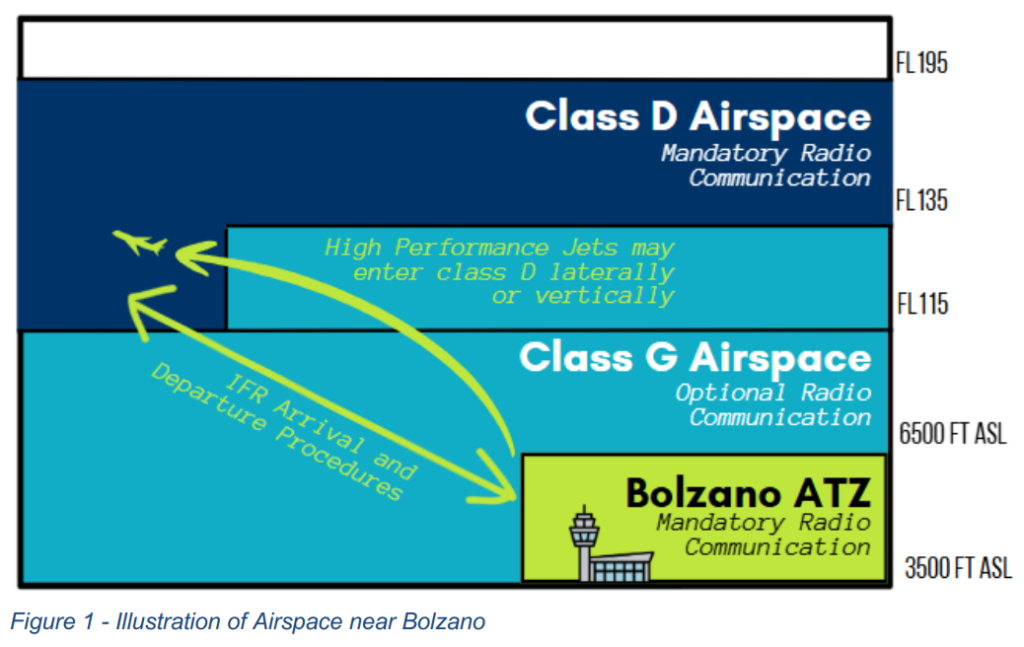
2.13.7. Ad hoc coordination measures between ATC, FIS, and AFIS have evolved, effectively creating hybrid control practices within uncontrolled airspace. While operationally pragmatic, such arrangements:
- Are not globally standardised;
- Risk misunderstanding by crews;
- Conflict with fundamental Class G principles. (ENAC, 2024)
2.14. Regulatory Framework at Global, Regional, and National Level
2.14.1. This section sets out a hierarchical regulatory objective, distinguishing between responsibilities at ICAO level (standards and SARPs), regional authorities (e.g. EASA), and States, to achieve consistency while allowing proportionate local implementation.
2.14.2. The diversity of practices worldwide demonstrates the urgent need for regulation. Examples include:
- States where CAT operations are prohibited at uncontrolled aerodromes;
- States where limited sequencing or coordination is provided through local procedures;
- States applying specific measures such as Mandatory Broadcast Zones (MBZ) and protected instrument approach areas.
2.15. While these approaches address local needs, they lack global consistency. There must be an establishment of clear, harmonised regulations that define where and under what conditions IFR departures and arrivals may be conducted in uncontrolled airspace. Responsibilities shall be clearly allocated between ATC, FIS, and flight crews. Minimum safety requirements for procedure design, traffic information, and coordination shall be established. Capacity management and mixed IFR/VFR operations shall be addressed and assessed. Lastly, legal clarity and protection for aviation professionals acting in accordance with the published procedures shall be provided.
2.16. This case demonstrates the limits of local mitigation measures and highlights the need for structured regulatory intervention.
2.17. Existing policies ADME 2.5, 2.7 and ATS 3.3 address the concernshighlighted by this paper. These policies can be a powerful tool in situationswhere the appropriate airspace classification, procedures and legal responsibilities are not in place.
Conclusion
3.1. Apart from the classification and rules regarding uncontrolled airspace, there are no other regulations with reference to commercial and non-commercial traffic operating in this kind of airspace and airports located inside.
3.2. In the past, this type of operation was limited to few airfields, usually located in remote areas and where the number of movements was so limited not to justify investments in air navigation technologies, systems and services. Now, on-board systems can allow instrument procedures using technology that is cheaper to maintain, using satellites, for example. The number of IFR movements at uncontrolled airports is increasing, pushing the technical, physical and environmental characteristics of these airports, to potentially critical limits.
3.3. The lack of international and general standardized rules determines inconsistency, safety risks and legal uncertainty. Variations in regulations among regions, nations and airports can create confusion for operators, creating an undesirable situation. A full analysis of the technical and legal aspects should be conducted, and efforts should be made to raise attention to this regulatory gap in the appropriate professional forums. IFATCA should push for ICAO global standards, especially clarifying FIS, ATC and pilot responsibilities.
3.4. Considering all the above the validity of existing IFATCA policies as reported in ADME 2.5, ADME 2.7, and ATS 3.3 is evident.
3.5. In the meanwhile, if appropriate rules and regulations are not in place yet, the appropriate authorities, where required, should establish:
- Clear and efficient procedures, including aeronautical publications and letters of agreement among stakeholders, to grant safe operations between IFR and IFR vs. VFR traffic;
- A strategic airport capacity for an efficient and safe management of the traffic;
- Global standards for IFR operations at uncontrolled aerodromes;
- Clearly defined FIS roles, limitations, and training when handling IFR/PBN procedures;
- Legal frameworks to protect operators and service providers.
Recommendations
4.1. It is recommended that this working paper be accepted as information material.
References
Airport Capacity Assessment Methodology (ACAM) Manual – Appendis A. EUROCONTROL. (2016). https://www.eurocontrol.int/publication/airport-capacity-assessmentmethodology-acam-manual
EASA. (2012). Commission regulation (EU) no 965/2012 – air operations. https://www.easa.europa.eu/en/document-library/regulations/commissionregulation-eu-no-9652012
EASA. (2023). Easy Access Rules for the Basic Regulation (Regulation (EU) 2018/1139) Art 3. https://www.easa.europa.eu/en/document-library/easy-accessrules/easy-access-rules-basic-regulation-regulation-eu-20181139
ENAV. (2024, April). AIP Italia – AD2 LIPB. https://onlineservices.enav.it/enavWebPortalStatic/AIP/AIP/(A02-26)_2026_02_19/index.html
ICAO. (n.d.). Home page – ICAO data+. Glossary – ICAO Data+. https://dataplus.icao.int/
ICAO. (2023). Doc 10084 Risk Assessment Manual for Civil Aircraft Operations Over or Near Conflict Zones. https://www.icao.int/sites/default/files/Security/SFP/Documents/Doc.10084.Thirdedition.pdf
IFATCA. (2022a). ADME 2.5 provision of ATS at aerodromes. ADME 2.5 PROVISION OF ATS AT AERODROMES. https://ifatca.wiki/kb/tpm/adme/adme-2-5-provision-ofats-at-aerodromes/
IFATCA. (2022b). ADME 2.7 the interface between ATC and AFIS. ADME 2.7 THE INTERFACE BETWEEN ATC AND AFIS. https://ifatca.wiki/kb/tpm/adme/adme-2-7-the-interface-between-atc-and-afis/
IFATCA. (2022c). ATS 3.3 harmonisation of the Airspace Classification. ATS 3.3 HARMONISATION OF THE AIRSPACE CLASSIFICATION. https://ifatca.wiki/kb/tpm/ats/ats-3-3-harmonisation-of-the-airspace-classification/


