
DISCLAIMER
The draft recommendations contained herein were preliminary drafts submitted for discussion purposes only and do not constitute final determinations. They have been subject to modification, substitution, or rejection and may not reflect the adopted positions of IFATCA. For the most current version of all official policies, including the identification of any documents that have been superseded or amended, please refer to the IFATCA Technical and Professional Manual (TPM).
65TH ANNUAL CONFERENCE, Bucharest, Romania, 20-24 April 2026
WP No. 163
Egyptian ATC Excellence During Regional Airspace Closures Contingency Operations: Airspace Closure and Traffic Surge Response Within the Cairo FIR
Presented by EGATCA (Egypt)
| SUMMARY This paper presents a comprehensive overview of the contingency operations undertaken by the Cairo Flight Information Region (FIR) in response to a sudden regional airspace closure and the subsequent unprecedented surge in rerouted and diverted air traffic. It details the immediate actions, extensive coordination efforts with international and national stakeholders, and the effective measures implemented to ensure the safety, efficiency, and continuity of air traffic services. The successful management of a 220% increase in overflight traffic, including a significant volume of uncoordinated flights, underscores the importance of robust contingency planning and collaborative frameworks. |
Introduction
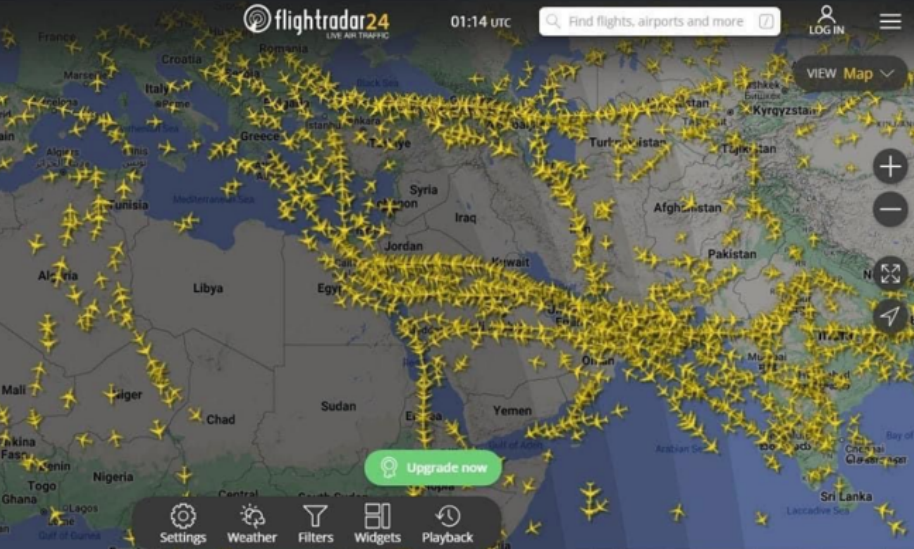
1.1 On 13 June 2025, the Cairo FIR was confronted with a critical operational challenge following the abrupt closure of a major regional airspace. This event necessitated the immediate activation of full-scale contingency protocols due to a significant increase in rerouted air traffic, many of which were operating with reduced fuel reserves.
1.2 This paper outlines the proactive and coordinated response of, National Air Navigation Service Company (NANSC), fast response and the success story of the Egyptian ATCOs and its Contingency Response Team (CRT) to manage this crisis, maintain operational integrity, and ensure the safety of all flights within its area of responsibility.
Discussion
- The Human Factor: How does a controller manage the psychological pressure of “heavy frequency” (constant radio talking) for several hours?
- Technology vs. Intuition: In a crisis, do you rely more on automated conflict alerts or your own spatial
visualization?
2.1. Situation Overview and Immediate Actions
Upon receiving information regarding the airspace closure, the CRT was immediately activated to assess and manage the evolving situation. Crucial initial steps included:
- Coordination with the ICAO MID Region Contingency Coordination Team (CCT).
- Acceptance of all rerouted flights under contingency measures, irrespective of prior coordination or flight plans.
- Handling an average of 700 flights on the first day, including approximately 100 flights per hour without prior coordination.
2.2. STAKEHOLDER COORDINATION
Continuous and robust coordination was a cornerstone of the successful response. The CRT maintained constant liaison with:
- Neighbouring FIRs to manage traffic flow at boundaries.
- ICAO MID Office for regional oversight and guidance.
- EUROCONTROL Network Manager (NM) and Contingency Coordination Committee (CCC) for European interface management.
- Internal stakeholders including ECAA Operations, Cairo International Airport, and the Egyptian Airports Company to ensure seamless ground-air integration.
Traffic Impact Assessment The airspace closure resulted in a dramatic increase in traffic volume within the Cairo FIR:
- Overall overflight traffic increased by 220%.
- Traffic over the KITOT waypoint specifically increased by 171%, highlighting a critical choke point.
2.3. MEASURES IMPLEMENTED
External Measures:
- Development and implementation of rerouting scenarios to optimize traffic flow and ensure flight level availability.
- Reduction of separation minima with adjacent ACCs (Area Control Centres) to enhance capacity, following agreed-upon safety assessments.
- Real-time coordination and information sharing with all affected stakeholders.
Internal Measures:
- Full mobilization of all air traffic controllers with valid ACC ratings.
- Strategic sector splitting to significantly enhance airspace capacity and distribute workload.
- Suspension of non-essential leave and administrative tasks to maximize operational staffing.
- Effective utilization of system-supported tools to reduce real-time coordination workload and improve situational awareness. Key Coordination Meetings and NOTAM Implementation Critical coordination meetings were held with key partners.
- Ensure compliance with coordinated Traffic Orientation Schemes (TOS).
- Mitigate pressure on CVO by rerouting overflow via J981–L550–T115 to LC (Nicosia FIR).
- Maintain PASAM fully operational.
- Open IMRAD for westbound traffic to support SANS and reduce load on PASAM and GIBAL.
- Routing HECC (Cairo International Airport) arrivals via KITOT (~100 flights/day).
- Routing LC-bound flights via KITOT (~50 flights/day).
- Utilizing IMRAD/GIBAL as alternative entry/exit points.
- Directing eastbound traffic via KITOT instead of SILKA.
- Permitting DCT (Direct) SHM–HLF instead of SILKA.
2.4. Stakeholder Feedback The effectiveness of the contingency operations was affirmed by positive feedback from key stakeholders:
- IATA: Commended the excellent handling and zero delays.
- ICAO: Appreciated timely planning and coordination.
- EUROCONTROL: Acknowledged the effectiveness of implemented procedures. Daily coordination with all stakeholders was consistently maintained throughout the crisis.
Conclusion
3.1. The response of the Cairo FIR to the regional airspace crisis exemplified swift, dynamic, and highly coordinated contingency operations. Through proactive planning, real-time monitoring, and continuous engagement with all stakeholders, the Cairo FIR successfully managed an unprecedented surge in air traffic while upholding the highest standards of safety and efficiency. Egypt remains committed to supporting regional stability and ensuring seamless air traffic operations in cooperation with all international and national partners. The experience gained from this event provides valuable insights for enhancing global contingency planning.
Recommendations
4.1. Set a prepared contingency plan with all the FIRs related to be ready anytime for any changes and to avoid workload on the ATC and any confusion with the airlines.
References
5.1. ICAO Annex 11 – Air Traffic Services
5.2. ICAO MID DOC 003
5.3. Egypt’s measures during the crisis


