
DISCLAIMER
The draft recommendations contained herein were preliminary drafts submitted for discussion purposes only and do not constitute final determinations. They have been subject to modification, substitution, or rejection and may not reflect the adopted positions of IFATCA. For the most current version of all official policies, including the identification of any documents that have been superseded or amended, please refer to the IFATCA Technical and Professional Manual (TPM).
65TH ANNUAL CONFERENCE, Bucharest, Romania, 20-24 April 2026
WP No. 161
Update on Environment Working Group and Latest European Initiatives on Environment
Presented by SESAR and EASA Liaison Officer
| SUMMARY While air connectivity brings significant socio-economic benefits, it also comes with environmental challenges such as aircraft Green House Gas emissions (GHG) and noise. Aircraft emit gases and particles directly into the upper troposphere and lower stratosphere where they have an impact on atmospheric composition. These gases and particles alter the concentration of atmospheric greenhouse gases, including carbon dioxide (CO2), ozone (O3), and methane (CH4); trigger formation of condensation trails (contrails); and may increase cirrus cloudiness—all of which contribute to climate change. ICAO adopted in 2022 the international agreement on carbon reductions from aviation, called long-term aspirational goal (LTAG of net-zero carbon dioxide (CO2). The European Union has adopted the Green Deal and the Fit for 55 Package aiming at reducing 90 % of transport emissions by 2050. From 1.1.2025, as part of the European Emission Trading Scheme (EU-ETS) need to monitor, report and verify as well non-CO2 aviation effects. Various efforts are addressing the Environmental Subjects, such as Climate Change Adaptation, Sustainable Aviation Fuel (SAF) and energy propulsion, Environmental performance assessment and non-CO2. In Europe SESAR research projects several work on these subjects. IFATCA has been providing operational advice to these Research Project. From June 2026 onwards IFATCA is part of a research project on Environmental impact of aviation called Zenitia. The Environmental working group met online 5 times from conference 2025 to upcoming conference. Several presentations from CANSO, World Meteorological Organisation and Eurocontrol were presented to the members of the working group present. IFATCA together with Eurocontrol will organise a conference on the topic of Managing the Operational Impact of Aviation Climate Targets on 1st of October 2026 in Brussels. |
Introduction
1.1. The International Civil Aviation Organisation (ICAO), in 2023, adopted a longterm aspirational goal (LTAG) of net-zero emissions from international aviation by 2050. The LTAG aligns with the United Nations Framework Convention on Climate Change (UNFCCC) and the Paris Agreement (COP21). The Paris Agreement wishes to see that CO2 emissions are reduced to limit global warming to 1.5 °C relative to the pre-industrial age and an absolute limit set to keep global warming well-below 2.0 °C (ICAO, 2022).
1.2. The goal reinforces industry and government commitment to aviation’s decarbonization as expressed in the 2016 Carbon Reduction and Offsetting Scheme for International Aviation (CORSIA). CORSIA established an offsetting program for growth in emissions beyond a 2020 baseline (“carbonneutral growth”). The new agreement, on the other hand, establishes a goal of net-zero CO2 emissions from aviation by 2050 and encourages states to develop State Action Plans (SAPs) for achieving this goal. It also encourages promotion of alternative fuels and development of alternative technology.
1.3. The political will to reduce aviation emissions exists and is manifested through various initiatives, such as, the “European Green Deal” for the EU adopted in 2019 and the “Fitfor55 Package”, by which the EU adopted new targets to reduce GHG emissions to at least 55% below 1990 levels by 2030 (previously 40%). According to the Green Deal communication, a 90 % reduction in transport emissions would be needed by 2050 to achieve a climate neutral economy.
1.4. The EU Emissions Trading System (EU ETS, Directive 2003/87EC) requests from the 1st of January 2025 all aircraft operators subject to the Monitoring and reporting of GHG emissions (Directive 2007/589). The so-called MRV1 (monitoring, reporting and verification) (Commencing January 1st, 2025, aircraft operators under the purview of the EU ETS will have the added responsibility of monitoring and reporting their non-CO2 effects, which encompass soot particles, water vapour, nitrous oxides (NOx) and oxidised sulphur species. The European Commission is launching a new IT tool called the Non-CO2 Aviation Effects Tracking System (NEATS) to automatise the monitoring and reporting process).
1.5. IFATCA policy exists on Environmental impact on ATM operation, which is currently under review by a PLC paper for conference 2026.
1.6. IFATCA together with other professional staff organisation (ATCEUC, ECA, ETF and IFATSEA), has submitted a position paper (Aviation Sustainability – Huma Operators approach and considerations about the ATM component) in 2022, to Single European Sky ATM Research (SESAR) Joint Undertaking.
1.7. IFATCA Environmental working group has met online 5 times since conference 2025. Three presentations provided by CANSO, the World Meteorlogy Organisation and Eurocontrol have provided the insight into the different challenges related to the Environmental measures having a potential impact on ATM operations.
1.8. Following a suggestion by IFATCA, Eurocontrol and SESAR accepted to coorganise a one-day conference on the topic of Managing the Operational Impact of Aviation Climate Targets on 1st of October 2026 in Brussels.
Discussion
2.1. Environment and it’s impact on Air Traffic Management
The impact on Air Traffic Management of the Environment actions needed to meet the different decarbonisation initiatives of the Aviation sector can be split into the following categories:
- ATM Infrastructure
- ATM Operations
Under ATM infrastructure the following sub-categories have been identified so far:
- Reduce to zero net operation
- Energy, IT, building, travel
- Commuting of Staff
- Offsetting the IT energy consumption
- Solarpanel and Wind energy for remote sites
Under ATM Operations the following categories have been identified so far:
- Free Route airspace
- Horizontal Flight Efficiency
- Vertical Flight Efficiency
- Noise abatement procedure
- Taxi out time
- Continuous Climb/Descent and,
- Contrail avoidance
2.2. Aviation Sustainability – Human Operators approach and considerations about the ATM component
Under the SESAR contract IFATCA and other Professional Staff Organisations had the possibility to produce a position paper on Environmental issues. Largely inspired by the IFATCA policy this paper called Aviation Sustainability – Human Operators approach and considerations about the ATM component.
The main request from the Staff organisation were:
Ensure that the level of safety shall be maintained or improved when environmentally driven procedures are introduced;
- Ensure that all individual environmental factors are identified and considered while establishing procedures;
- The actual values (noise levels, fuel consumption and the level of emissions) of the various individual environmental contributors of new or existing procedures should be established in detail for transparency purpose;
- The interrelation of the various individual environmental factors should be identified and addressed.
- IFATSEA proposes to add ANS/ATM systems, services, architecture and configurations are ensuring the required Resilience and QoS to enable Operational Efficiency and Green operations.
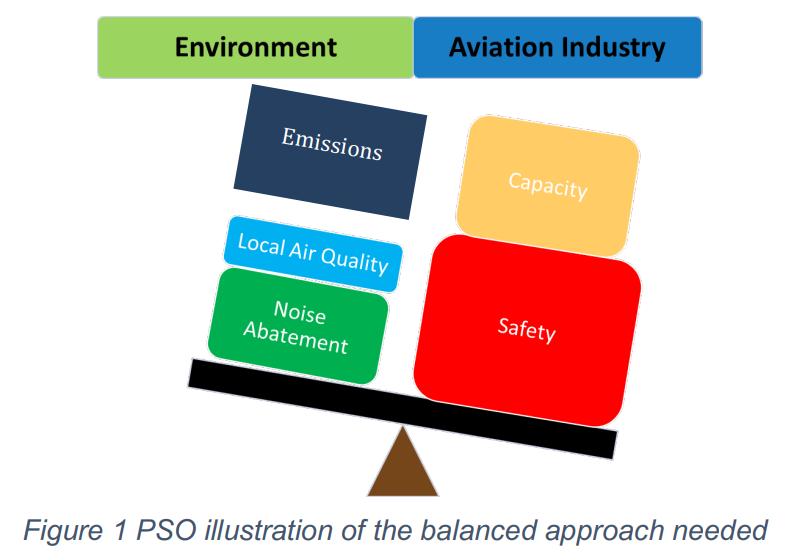
2.3. The position paper further requests an environmental case like we have safety cases for all the changes in the ATM system.
Provisions for an environmental case should comprise at least the following requirements:
- An environment case is a documented body of evidence that provides argument that a certain procedure is optimised for all individual environmental factors as prioritised by the appropriate authorities.
- An environment case should provide a detailed overview to the appropriate authorities for the determination of priorities of the individual environmental factors on a strategic level.
2.4. Further the position paper argues that the front end-user (ATCOs, Pilots and ATSEP to a certain extent) can manage the impact of environmentally driven procedures in a safe and efficient way. Thus, it was proposed to use the ICAO conflict management layer (ICAO, Doc 9854) when introducing new environmental procedure (including noise, CO2 and non-CO2). IFATCA since the publication of this paper (2021) has repeatedly called upon the Eurocontrol Network Manager to manage the CO2 trajectory for flights above 1500km, as it is illusionary to leave the management of a CO2 trajectory by individual ANSP or ATS units. As the non-CO2 (contrails) (Non-CO2 avoidance, measurement and scientific evidence can be found in AAE_Avis20_UK_WEB.pdf chapter 4 p. 41 ff) avoidance is scientifically on very insecure ground, IFATCA has not yet been able to identify the best vehicle to cross-border manage the areas prone for contrails formation.
2.5. The ICAO conflict management layer
Was created by ICAO during the discussion leading to the Global ATM Concept. This conceptual approach (see annex to this paper) is very helpful as it argues for a clear separation of strategical, tactical actions when introducing new procedures of any sort.
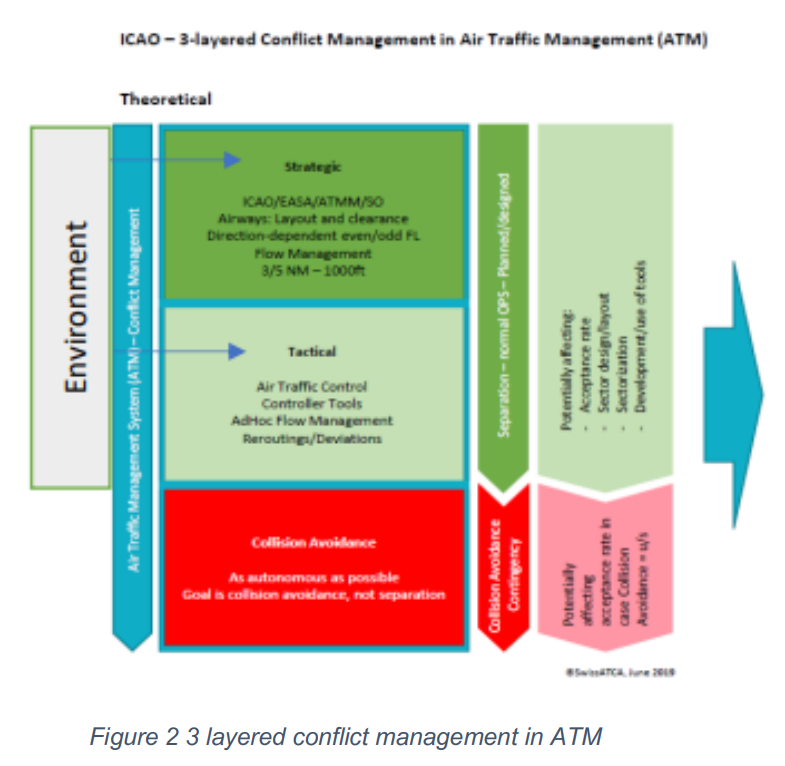
2.6. Work Program of Environmental Working Group (ENV WG)
The Environmental Working Group decided to work along the following items to structure its work.
- Learn from other organization
- Provide guidance and education to members member associations
- Possible provide policy proposals to Directors
- Engage with different aviation bodies and disseminate the guidance and IFATCA policies on Environment
This shall be achieved by being involved with Research and Regulatory bodies studying and discussing ENV matters, organise exchanges with CANSO, Eurocontrol, WMO and ICAO). Provide education and guidance material to member associations.
2.7. Composition and work carried out of ENV WG
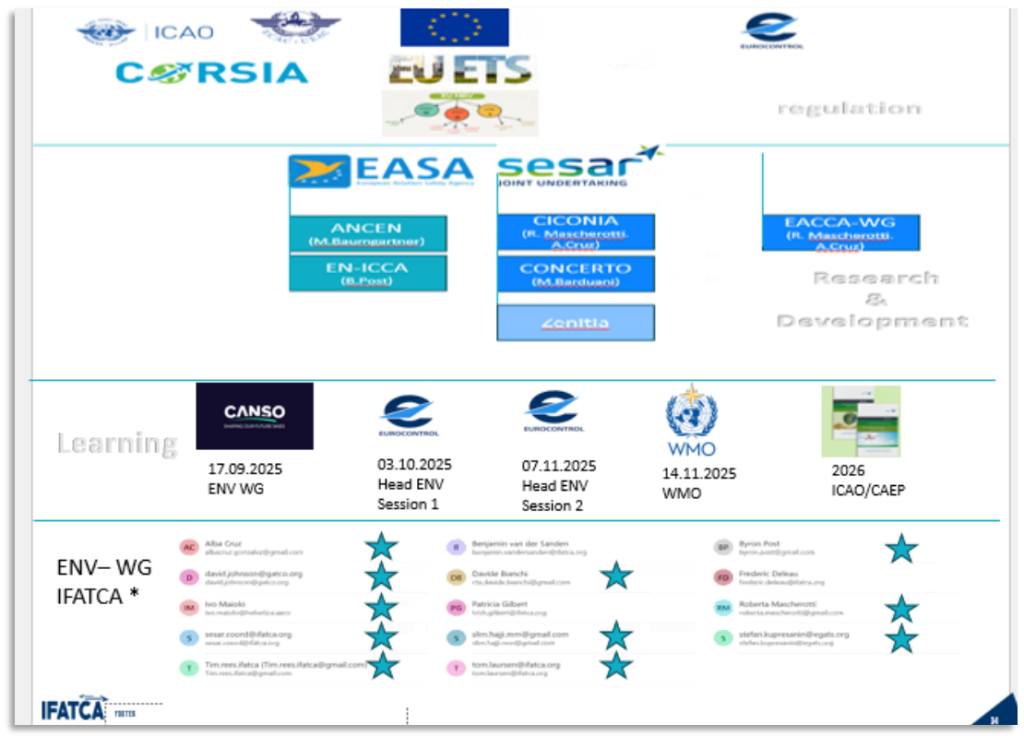
Figure 3 IFATCA overview of ENV WG activies
2.7.1. Learn from others
The ENV WG met with CANSO Environmental Working Group for a presentation and discussion. The ppt is available as Annex 1.
The ENV WG met with World Meteorological Organization. The presentation reviewed the lates Findings on the impact of Climate change and Variability on Aviation. The ppt is available as Annex 2.
Two sessions with the Head of the Sustainability Unit of Eurocontrol took place. A very complete and detailed presentation on the impact on ATM of the climate changes. The ppt is available as Annex 3.
The exchange with ICAO has not yet been organised and is planned for 2026 and in coordination with the EB and the ANC Representative of IFATCA.
2.7.2. In Europe members of the Environmental working group have continued to follow the SESAR Research projects and attended the Advisory and Stakeholder consultation of the following Research projects:
Green-GEAR- Green operations with Geometric altitude, Advanced separation and Route charging Solutions. IFATCA participates to the Advisory Board (Rep. Marc Baumgartner)
AEROPLANE- Advancing Measures to Reduce Aviation Impact on climate and enhance resilience to climate-change. IFATCA participates to the Advisory Board. (Rep. Roberta Mascherotti).
CICONIA- Climate effects reduced by Innovative Concept of Operations – Needs and Impacts Assessment (Rep. Roberta Mascherotti).
CONCERTO- Dynamic Collaboration to Generalize Eco-friendly Trajectories (Rep. Mauro Barduani).
GALAAD- Green Aviation – Lean Arrivals and Dynamicity. IFATCA was invited to assess the results of the GALAAD project by SESAR Joint Undertaking.
2.7.3. The European Aviation Safety Agency EASA has created an European Network on Impact of Climate change on aviation (EN-ICCA). IFATCA participates in this Network with Bryon Post, Alba Cruz and Roberta Mascherotti in this network.
Based on the IPCC assessment report No 6 the EN-ICCA works on phenomena like Storms and hurricances, heatwave, heavy precipitations, flooding and drought.
EASA further has created a Aviation Non-CO2 Experts Network (ANCEN), where Marc Baumgartner represents IFATCA.
2.7.4. Eurocontrol together with ACI has created European Aviation Climate Change Adaptation Working Group. IFATCA is represented by Roberta Mascherotti. and Alba Cruz IFATCA has contributed to surveys on hazards such as Volcano eruption and impact on ATM.
2.7.5. Engage with different aviation bodies and disseminate the guidance and IFATCA policies on Environment IFATCA has been invited in the implementation phase of the Single European Sky II+ legislation to contribute to a study on route charging modulation. To operate fuel-efficient trajectories, adopt alternative clean propulsion technologies and increase the use of sustainable aviation fuels.
2.8. Work Program 2026
2.8.1. SESAR
IFATCA will continue to follow the work of the above-mentioned Research programs by participating to the Advisory and Stakeholder Consultation bodies.
New, IFATCA is part of the Consortia ZENITIA (Zero-Emission NextGen Innovation and Technology Integration for Aviation) :
Achieving international climate goals requires evidence-based decisions on emerging aircraft technologies, operations and regulatory instruments. This demands robust pre-implementation assessments to quantify environmental benefits and anticipate the operational impacts of integrating next-generation fleets with new performance characteristics and infrastructure needs. However, current scientific knowledge is insufficient, with major gaps in modelling evolutionary and revolutionary (E/R) aircraft performance, emissions and environmental effects, as well as system-level analysis of mixed-fleet operations.
ZENITIA’s will develop high-fidelity models to estimate dynamic performance, emissions, and environmental impacts (CO₂, non-CO₂, air quality) of E/R aircraft; and optimisation frameworks for planning safe, efficient, and environmentally aligned gate-to-gate operations of mixed fleets. An artificial intelligence-driven decision-support platform translates these insights into operational, regulatory and policy guidance, supporting the seamless integration of next-generation aircraft and Europe’s transition towards climate-neutral aviation.
IFATCA will provide operational perspective to this 30 month research work.
2.8.2. Conference on Managing the Operational Impact of Aviation Climate Targets
IFATCA has proposed to SESAR JU and Eurocontrol to organise an operational impact conference on the topic of Aviation Climate targets. The aim being to create awareness of the regulatory environment and identify the possible impact on the Air Traffic Control operations in the future.
The conference will be co-organised by Eurocontrol and IFATCA and will take place at Eurocontrol, Brussels on the 1st of October 2026. It is open for all Members of IFATCA, and the agenda and the registrations instructions will be published in due time.
The international conference will look at topic of CO2 trajectories, nonCO2 management, The Human Component: Psychosocial Hazards, Noise and Local Air Quality and the Climate change impact on the infrastructure and the job of ATCOs.
2.8.3. Educational Material
The ENV WG will discuss the possibility to use modern communication features to start an educational campaign for the IFATCA Members and continue to work off the action plan agreed in the beginning 2025.
Conclusion
3.1. The ENV Working Group has met online exclusively.
3.2. Members of the ENV WG are participating to various Research and regulatory bodies activities in Europe.
3.3. In the quest to learn from others IFATCA has been presented by information from CANSO, Eurocontrol and WMO.
3.4. IFATCA will be able to work further on the ENV thanks to the SESAR Research project Zenitia.
3.5. Educational material for all the members is envisaged to be produced in the coming year.
3.6. Interested members from any of the Member Association are welcome to join the Working Group.
Recommendations
It is recommended that this working paper is accepted as information material.
Annexes
5.1. CANSO ENVIRONMENTAL WORKING GROUP


