
DISCLAIMER
The draft recommendations contained herein were preliminary drafts submitted for discussion purposes only and do not constitute final determinations. They have been subject to modification, substitution, or rejection and may not reflect the adopted positions of IFATCA. For the most current version of all official policies, including the identification of any documents that have been superseded or amended, please refer to the IFATCA Technical and Professional Manual (TPM).
65TH ANNUAL CONFERENCE, Bucharest, Romania, 20-24 April 2026
WP No. 103
Integrating High Altitude Operations
Presented by TOC
| SUMMARY This information paper analyses issues regarding the integration of high altitude operations – a specific type of new entrant to civil aviation – in the context of proposals by industry to operate within existing controlled airspace but be exempt from air traffic control clearances and instructions in certain circumstances. The applicability of the Chicago Convention is affirmed, and ongoing work at ICAO is described. |
Introduction
1.1. With recent advances in aeronautical technology, there has been a surge in the development of new and unique aircraft. The way in which many of these new aircraft operate does not conform to the way in which existing civil aircraft operate – these new aircraft are intended to operate higher or lower, faster or slower, use alternative propulsion methods, and/or pursue unique mission objectives.
1.2. Together, these new aircraft and their operators are sometimes referred to as ‘new entrants’ to international civil aviation. The operations of these new entrants have the potential to significantly impact the conduct of international civil aviation, and work is being undertaken by a handful of organisations on integrating these various new entrants in an organised manner.
1.3. One type of new entrant is ‘high altitude operations’ – operations by new and unique aircraft within the stratosphere. While high altitude operations are currently limited in number, it is possible that their use may increase significantly in the future; therefore, the effect of these aircraft on the roles and responsibilities of air traffic controllers (ATCOs) is a matter of relevance for IFATCA and its member associations.
Discussion
2.1. The term ‘high altitude operations’ is often used to refer to those flights which are mostly conducted within the stratosphere. Some traditional civil aircraft with a pilot on board already operate within the lower reaches of the stratosphere; however, it is generally considered that high altitude operations also demonstrate some form of non-conformance with traditional civil aviation. Such non-conformance may be that the aircraft fly slower (e.g., solar-powered slowflying winged aeroplanes), faster (e.g., hypersonic aeroplanes) or are less manoeuvrable (e.g., airships and balloons) than most aircraft currently used in international civil aviation.
2.2. Some literature refers to these aircraft as ‘vehicles’ in order to make a distinction from traditional aircraft; however, in this paper we will refer to them as aircraft, because in accordance with Annex 2 — Rules of the Air an aircraft is defined as “any machine that can derive support in the atmosphere from the reactions of the air other than the reactions of the air against the earth’s surface” (ICAO, 2024a, p. 1-2). Therefore, a balloon, an airship, a glider, and even a hydrogen-fuelled, rocket-propelled, hypersonic remotely piloted aeroplane are all aircraft. On the other hand, vehicles operating beyond the stratosphere, including rockets and satellites, are not aircraft and are generally not considered to be part of high altitude operations.
2.3. When analysing high altitude operations, it is important to understand the characteristics of the stratosphere. The exact height of the stratosphere varies with latitude and other factors, but in the mid latitudes it exists between approximately 40 000 ft (12 000 m) and 170 000 ft (50 000 m) above mean sea level. Conditions within the stratosphere are characterised by the presence of significant cosmic radiation and ozone, and temperatures as cold as -65° C. Additionally, it is estimated that 80% of the atmosphere’s air mass exists below 50 000 ft (15 000 m), while above 65 000 ft (20 000 m) there is very little air at all (HAPS Alliance, 2021).
2.4. For the purposes of this paper, high altitude operations will be considered as aircraft conducting most of their flight in the stratosphere, and which do not readily conform with the operations of traditional civil aviation.
2.5. Recalling that in accordance with Annex 2, an aircraft derives support in the atmosphere from the reactions of the air, this means that for aircraft operating in the stratosphere, the scarcity of air can make flight difficult. Nonetheless, one unique characteristic of the stratosphere is that it features stable atmospheric conditions. Because air temperature increases with increasing height within the stratosphere, the vertical movement of air is impeded, and the stratosphere is therefore almost completely free of clouds and weather such as thunderstorms, which can affect aircraft operations and damage aircraft structures.
2.6. Figure 1 below provides a simplified illustration of where the stratosphere is located within the Earth’s atmosphere, and the height of high altitude operations compared to traditional civil aviation, low earth orbiting satellites and geostationary satellites.
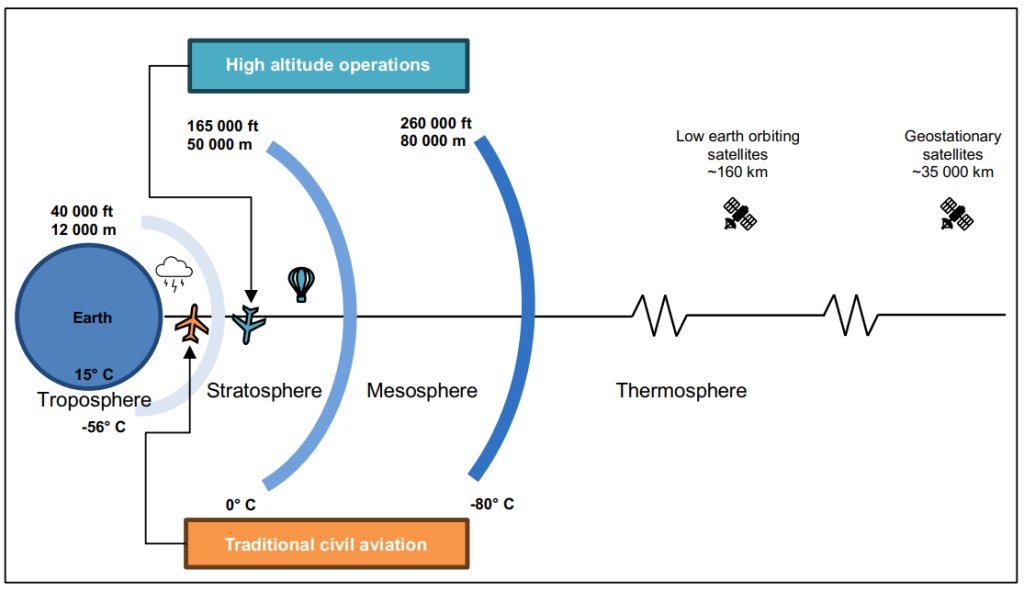
Figure 1. The Earth’s atmosphere
2.7. One well-published use case for high altitude operations is loitering platforms for overhead imagery and communications. The Airbus Zephyr is an example of a slow loitering aircraft designed to operate within the stratosphere: The Zephyr is remotely piloted, solar-electric powered, and can fly continuously for months in the stratosphere (Airbus, 2025). The Prismatic PHASA-35 is a similar remotely piloted slow loitering aircraft which has conducted demonstration flights in the stratosphere (BAE Systems, 2025). Meanwhile Australian firm Stratoship has conducted demonstration flights in the stratosphere with a remotely piloted airship (Stratoship, 2025).
2.8. Numerous organisations are planning to – or already have – establish comprehensive coverage of the Earth’s surface using low earth orbiting satellites. This raises the question of what benefits high altitude operations can bring over such satellites. While low earth orbiting satellites may be popular, they do have some inherent limitations, e.g., they do not maintain a constant position relative to the Earth’s surface (in other words, a low earth orbiting satellite will not remain stationary in the sky from the perspective of an observer on the ground). Therefore, an extensive network of low earth orbiting satellites must be launched and maintained in service in order to provide coverage of a specific area. An example of such a network is the Aireon space-based ADS-B network, which uses ADS-B receivers placed on each of the Iridium NEXT constellation of 66 low earth orbiting satellites (IFATCA, 2014). If global coverage isn’t required (e.g., if an organisation only requires coverage of a small area), one or two high altitude aeroplanes or airships might provide similar coverage to a network of low earth orbiting satellites.
2.9. The HAPS Alliance is a collection of aeronautical and telecommunication organisations formed to advocate for the advancement of high altitude operations. The mission of the HAPS Alliance is to ‘unlock the stratosphere to enhance connectivity and sensing services for civilian and government applications globally’ (HAPS Alliance, 2020). Governmental/regulatory interest in high altitude operations is also growing, and the European Concept for Higher Airspace Operation (ECHO) describes high altitude operations for all new entrants, ranging from low-speed high-altitude platform systems to very high-speed operations notably supersonic and hypersonic transport, plus commercial space activities conducted from and to European States, through the EUROCONTROL Network Manager area of responsibility. It also includes the methods of transit through regular air traffic services airspace (EUROCONTROL, 2022, p. 8). While State and industry-based activities will likely be the driving force behind early developments in high altitude operations, the international regulatory framework will influence how these operations occur over the high seas and across borders.
2.10. The Chicago Convention grants the State sovereignty of the airspace above its territory (ICAO, 2006). The Chicago Convention does not define a vertical limit to that sovereignty, and there is no internationally agreed limit to its vertical extent. Harrington (2016) presented the many proposed methods of defining the upper limits of sovereignty, including the so-called Kármán line situated approximately 300 000 ft (100 000 m) above mean sea level, the upper limit of the Earth’s atmosphere, the limit of the Earth’s gravitational effects, and the limit of effective State control. Even in the absence of an internationally agreed vertical limit to sovereignty, it is notable that each of the potential methods described above occurs at a level which is much higher than the level at which an aircraft can sustain flight due to the reactions of the air.
2.11. From an ATC perspective, the upper limit of State sovereignty is less important than the upper limit of the ATCO’s area of responsibility. States currently define the upper limit of controlled airspace and flight information regions differently: Some States such as Australia define the upper limit of their flight information region as FL600 (Airservices Australia, 2026), some States such as the United Kingdom set a limit of FL660 in some areas (NATS, 2026), while other States such as India claim a flight information region which is unlimited in height (Airports Authority of India, 2026).
2.12. The Chicago Convention (ICAO, 2006, p. 2) states that it ‘shall be applicable only to civil aircraft’. Although the concept of high altitude operations infers new and non-conforming entrants, as discussed above, many of the vehicles proposed for use conform to the definition of aircraft in Annex 2, and as long as they operate as aircraft (i.e., deriving support in the atmosphere from the reactions of the air) they will – by physical necessity – be operating below any of the proposed demarcating lines between airspace and space, and they will fall under the remit of the Chicago Convention (unless operating as a State aircraft). Therefore, it is expected that civil aircraft used in high altitude operations will conform with the Chicago Convention and the various standards and recommended practices (SARPs) contained in the Annexes. Indeed, Annex 2 already contains SARPs for the operation of unmanned free balloons which can operate higher than 60 000 ft.
2.13. If SARPs already exist and apply to high altitude operations, why do high altitude operations deserve special attention? As described earlier, the stable nature of the stratosphere can be conducive to aircraft operations, and some of the aircraft designed for the stratosphere are relatively light and structurally fragile to take advantage of stable atmospheric conditions; however, these aircraft must still transit through the troposphere, which can pose challenges. Even moderate unexpected weather has been seen to cause catastrophic failure, such as when a Zephyr aircraft crashed in Australia due to vertical air movement beyond the aircraft’s control authority (Australian Transport Safety Bureau, 2019). Therefore, even when these aircraft will primarily operate higher than regular aviation, any operational difficulties will impact on the wider environment. Like with many new technologies and operational concepts, it is likely that initial operations will be conducted in special use airspace so that the high altitude aircraft are segregated from other aircraft. This approach provides a quantum of safety during trials but is not a basis for long-term operations at scale.
2.14. When the TOC first investigated the subject of high altitude operations in 2023, it identified that there were not any special considerations applicable within the global provisions (IFATCA, 2023). Subsequently, at the fourteenth Air Navigation Conference (ANConf/14), it was recommended that ICAO develop a global concept for high airspace operations and also develop provisions allowing safe and efficient transit through controlled airspace, separation management, and procedures for uncontrolled descents (ICAO, 2024b). In response, the Air Navigation Commission referred the matter of concepts to the Air Traffic Management Requirements and Performance Panel (ATMRPP), and referred the matter of separation to the Separation and Safety Panel (SASP). IFATCA officers are nominated members to both the ATMRPP and the SASP, which will ensure that the perspective of ATCOs is taken into account when pursuing these tasks.
2.15. Of particular concern for ATCOs is the desire of some organisations for high altitude operations to be partially excluded from the air traffic services even when operating within controlled airspace. The HAPS Alliance proposes that these aircraft would climb and descend as regular remotely piloted aircraft and participate in the existing air traffic services, but that a new methodology is necessary to facilitate the dynamic nature of high altitude operations. The HAPS Alliance proposes that separation between high altitude aircraft would be maintained using data sharing and automation – a ‘managed automated fleet’ (HAPS Alliance, 2025, pp. 24-29). In effect high altitude aircraft operators would become responsible for separating their own aircraft from each other, and operators would cooperate to separate their aircraft from the aircraft of other operators.
2.16. The simplest way in which to facilitate this alternative means of separation would be a new vertical boundary at a sufficiently high level – one which is high enough to avoid traditional civil aviation, and which coincides with a standardised vertical limit of controlled airspace, e.g., FL600. In this simple model, a high altitude aircraft would depart and climb subject to ATC clearance, and upon reaching the boundary level, would cease to receive air traffic services and would commence operations in accordance with the new methodology. However, the HAPS Alliance proposes that there would be no fixed vertical boundary established to segregate high altitude operations from traditional civil aircraft, and instead, a variable lower limit for the new high altitude operating methodology would be established based on the likelihood of interaction between traditional civil aircraft and high altitude aircraft. Notably, this would apply even when the high altitude aircraft were operating in controlled airspace, e.g., at FL500 where the upper limit of Class A airspace is FL600.
2.17. Such a methodology whereby operators self-separate is not currently supported by Annex 11 — Air Traffic Services and is optimised for a fully automated environment. It is difficult to foresee how this proposal would be compatible with the existing human-centred air traffic management system as set out in the SARPs and PANS as they exist today. Notably, procedures for the delegation of separation to pilots is described in the Procedures for Air Navigation Services — Air Traffic Management (PANS-ATM, Doc 4444) only for subsequent aircraft conducting visual approaches, and for flights remaining in visual meteorological conditions and operating in classes D and E airspace.
2.18. A high altitude aircraft operating within controlled airspace will need an ATC clearance for its operations – whether that is at a controlled aerodrome, during climb/descent through the low levels, or at the very upper limits of controlled airspace as established. When that high altitude aircraft comes into conflict with another aircraft (e.g., a slow, solar powered winged aeroplane climbing to FL600 might come into conflict with a business jet cruising at FL470), the ATCO will be obliged to apply the separation minima which are applicable to those flights, including by issuing instructions to the high altitude aircraft to adjust its trajectory.
2.19. When a high altitude aircraft comes into conflict with other aircraft, the ATCO can be expected to apply priorities as established in the PANS-ATM which establish that an aircraft at a cruising level has priority over another aircraft requesting that level, and that the preceding aircraft has priority when two aircraft are at the same level (ICAO, 2025, p. 5-3).
2.20. Adverse outcomes may arise if the high altitude aircraft is unable to accept the terms of such an ATC clearance, e.g., because it is unable to manoeuvre or because to do so would jeopardise other separation being applied between multiple high altitude aircraft unknown to the ATCO. Any self-separation scheme for high altitude aircraft will need to be capable of facilitating separation applied within controlled airspace, and while the HAPS Alliance proposal identifies areas of minimum probability of interaction between traditional civil aircraft and high altitude aircraft, ATCOs must always apply the appropriate separation minima between all aircraft within controlled airspace. There must be clear and functional provisions for managing conflicts between traditional aircraft and high altitude aircraft for when they do occur in controlled airspace, and a perceived low risk of interaction does not release high altitude aircraft from their obligations under Annexes 2 and 11.
2.21. Complications may also arise when a potentially slow, fragile and slow-tomanoeuvre high altitude aircraft departs from a controlled aerodrome and passes through controlled airspace on climb to commence its high altitude of operations. As a civil aircraft, such operations will be subject to the same rules as other aircraft, and the high altitude aircraft should be sufficiently manoeuvrable to respond to ATCO clearance and instructions. Similar considerations will apply when a high altitude aircraft is on descent through controlled airspace to land.
2.22. The proposal from the HAPS Alliance for the ‘managed automated fleet’ selfseparation methodology may demonstrate strengths where particularly fast, slow and perhaps swarming aircraft are operating in proximity. Nonetheless, the proposed variable lower limit of the self-separation areas raises concerns where that lower boundary will be in controlled airspace under the jurisdiction of one or more ATCOs. How would such a variable boundary be communicated to ATCOs? How would that boundary be compatible with existing procedures for priority for use of airspace? The quasi-use of airspace volumes within controlled airspace also resembles the airspace management service, which is a separate service from the air traffic control service. ATCOs are not normally tasked with coordinating the airspace management service, which requires different competencies, operates in different time frames, and pursues different objectives from the air traffic services. Additionally, while ATCOs may withhold clearances in international airspace under their jurisdiction to maintain separation minima, restricting access to international airspace by enforcing a quasi-airspace reservation is contrary to the usual administration of international airspace, to which all States possess equal access rights.
2.23. While the industry’s desires and operational practicalities may justify the need for a new methodology to allow high altitude operations to operate safely in the stratosphere, it is clear that such a methodology must be in conformance with the international regulatory framework. Changes to the regulatory framework to support such new separation methodologies within controlled airspace will necessitate careful consideration and safeguards which manage the interface between a highly automated system and the human-centred air traffic services, ensuring there is no reduction in the safety, capacity or efficiency of the system designed for traditional civil aviation.
Conclusion
3.1. High altitude operations are an emerging new entrant to international aviation. They include aircraft operating both slow (e.g., airships and electric aeroplanes) and fast (e.g., hypersonic aeroplanes) within the stratosphere. While novel in many regards, high altitude operations nonetheless should be considered as civil aircraft (when operated by civil organisations), and therefore the Chicago Convention as well the SARPs contained in the Annexes apply equally.
3.2. Much work is being done to facilitate the operation of high altitude aircraft, and there exists a proposal for the ‘managed automated fleet’ whereby operators will assume separation responsibility between their own aircraft as well as with other operators’ high altitude aircraft.
3.3. The managed automated fleet is a response to the particular needs of the high altitude operations aircraft characteristics and the expected interaction of multiple aircraft in the stratosphere requiring de-confliction, yet the proposed methodology raises many questions surrounding the operation of the interface between traditional civil aviation and the air traffic services, with a fullyautomated methodology, potentially within the limits of controlled airspace.
3.4. While the industry may be capable of demonstrating a low likelihood of flight interaction between traditional civil aircraft and high altitude aircraft, ATCOs will nonetheless need procedures which allow them to apply separation minima between the aircraft and achieve the objective of the air traffic control service – preventing collision between aircraft. The current activities occurring at ICAO provides IFATCA with an opportunity to contribute to designing a system which meets the needs of the industry while ensuring that the high level of safety for traditional civil aviation is retained.
Recommendations
4.1. It is recommended that this paper is accepted as information.
References
5.1. Airbus. (2025). Zephyr High Altitude Platform Station. Retrieved from https://www.airbus.com/en/products-services/defence/uas/zephyr.
5.2. Airports Authority of India. (2026) Aeronautical Information Publication. New Delhi: Author.
5.3. Airservices Australia. (2026). Aeronautical Information Publication. Canberra: Author.
5.4. Australian Transport Safety Bureau. (2019). In-flight Break-up Involving Airbus Zephyr Unmanned Aerial Vehicle. Canberra: Author.
5.5. BAE Systems. (2025). PHASA-35. Retrieved from https://www.baesystems.com/en/product/phasa-35.
5.6. EUROCONTROL. (2022). European Concept for Higher Altitude Operations. Retrieved from https://www.sesarju.eu/sites/default/files/documents/reports/D4.3_ConOps_1.0_public.pdf.
5.7. HAPS Alliance. (2020). Overview – HAPS Alliance. Retrieved from https://hapsalliance.org/orverview.
5.8. HAPS Alliance. (2021). Driving the potential of the stratosphere. Retrieved from https://hapsalliance.org/wp-content/uploads/formidable/12/Driving_the_potential_of_the_stratosphere_HAPSAlliance_updated.pdf.
5.9. HAPS Alliance. (2025). Cooperative, Seamless, and Global Digital Skies for Higher Airspace. Retrieved from https://hapsalliance.org/wpcontent/uploads/formidable/12/HAPSAlliance-Global-Digital-Skies-HigherAirspace-Whitepaper-2025-updated.pdf.
5.10. Harrington, A. (2016). The Definition and Delimitation of Outer Space and the Safety of Aerospace Operations. Presentation to the International Association for the Advancement of Space Safety. Retrieved from https://www.unoosa.org/documents/pdf/copuos/lsc/2016/tech-03.pdf.
5.11. ICAO. (2006). Convention on International Civil Aviation (Doc 7030) (9th ed.). Montréal: Author.
5.12. ICAO. (2024a). Annex 2 to the Convention on International Civil Aviation — Rules of the Air (11th ed.). Montréal: Author.
5.13. ICAO. (2024b). Fourteenth Air Navigation Conference Report (Doc 10209). Montréal: Author.
5.14. ICAO. (2025). Procedures for Air Navigation Services — Air Traffic Management (Doc 4444) (16th ed.). Montréal: Author.
5.15. IFATCA. Technical and Operational Committee. (2014). Study Space-Based Automatic Dependent Surveillance – Broadcast. Working paper to the 53rd IFATCA Annual Conference, Gran Canaria, 2014. Montréal: Author.
5.16. IFATCA. Technical and Operational Committee. (2023). High Altitude Operations (HAO). Working paper to the 62nd IFATCA Annual Conference, Montego Bay, 2023. Montréal: Author
5.17. NATS. (2026). Aeronautical Information Publication. Whitely, Hampshire: Author.
5.18. Stratoship. (2025). Stratoship. Retrieved from https://stratoship.au.


