
DISCLAIMER
The draft recommendations contained herein were preliminary drafts submitted for discussion purposes only and do not constitute final determinations. They have been subject to modification, substitution, or rejection and may not reflect the adopted positions of IFATCA. For the most current version of all official policies, including the identification of any documents that have been superseded or amended, please refer to the IFATCA Technical and Professional Manual (TPM).
65TH ANNUAL CONFERENCE, Bucharest, Romania, 20-24 April 2026
WP No. 93
A Study of the Vertiport Concept
Presented by TOC
| SUMMARY The integration of vertiports into existing aerodrome infrastructure may require strategic adaptations within the Air Traffic Management framework to accommodate the high-density operations of energy-constrained eVTOL aircraft. As vertiports begin to integrate with established airport infrastructure, this paper explores considerations for ATCOs managing eVTOL operations within current frameworks, with attention to potential workload implications associated with varying aircraft performance profiles and wake turbulence challenges. |
Introduction
1.1. A Vertiport is defined by the European Union Aviation Safety Agency (EASA) as:
“An area of land, water or structure that is used or intended to be used for landing, take-off and movement of VTOL-capable aircraft (EASA, March 2022) [5.1].”
While Vertical Take-Off and Landing (“VTOL”) is defined by EASA as:
“a power-driven, heavier-than-air aircraft, other than aeroplane or rotorcraft, capable of performing vertical take-off and landing by means of lift and thrust units used to provide lift during take-off and landing (EASA, Regulation 2024/1111) [5.2]”
1.2. Unlike conventional airports with lengthy runways or heliports built for single helicopters, vertiports are compact hubs that may feature multiple final approach and take-off (FATOs) areas and dedicated “touch-and-go” pads known as touchdown and lift-off (TLOF). These locations facilitate rapid turnaround for battery-powered electric vertical take-off and landing (eVTOL) aircraft, and include fast charging stations, advanced acoustic monitoring systems, and digital docking technology. To boost efficiency, vertiports are set up so that only essential passenger boarding and de-boarding occur at the gate—streamlining operations and allowing numerous aircraft to function frequently and efficiently within a limited space (MDPI, July 2022) [5.3].
1.3. The evolution of vertiports infrastructure has rapidly progressed from simple “proofof-concept” landing pads to sophisticated “vertihubs”—advanced transport centres designed to integrate seamlessly with major transit routes and airport ecosystems. Modern designs prioritize efficiency and scalability, utilizing automated ground systems to support the principal “airport shuttle” business strategy, which aims to address last-mile congestion for premium travellers. By connecting city centres directly to airport terminals, these facilities allow operators to bypass ground traffic; however, economic viability relies on maintaining a high operational tempo where aircraft are seldom idle. Consequently, these hubs must function with minimal delays, guaranteeing access for landing and recharging to reduce traditional holding patterns.
1.4. This paper examines the role of air traffic control (ATC) in the context of integrating vertiports into existing airport infrastructure, highlighting the challenges posed by conflicting operational paradigms.
Discussion
2.1. Urban Air Mobility (UAM), Advanced Air Mobility (AAM) explained
2.1.1. AAM serves as the overarching framework for a transformative aviation ecosystem, integrating highly automated and sustainable technologies across diverse regional and local environments. Within this broad spectrum, UAM operates as a specific, targeted subset focused on localized, high-density aerial transport within metropolitan and suburban areas. To execute these UAM operations, the network relies on VTOL aircraft, which possess the unique performance characteristics required for agile, short-haul flights.
2.1.2. Finally, Vertiports provide the essential ground infrastructure—serving as the physical nodes where VTOLs launch, land, and recharge. Together, these elements are inextricably linked: AAM provides the overarching vision, UAM defines the urban mission profile, VTOLs serve as the operational vehicles, and vertiports anchor the entire system into tangible, day-to-day reality.
2.2. Vertiports
2.2.1. Vertiports might be situated at ground level, on elevated platforms (such as building rooftops), or on a dedicated infrastructure created to integrate vertiports/VTOL with other mobility systems (trains, buses, cars). Potential line of sight and surveillance limitations should be evaluated in these placements. Considering the airspace design, those structures might be allocated either in controlled airspace (including the airport’s perimeter) or outside it. This implies that ATS units should be called to service provision in accordance with the airspace classification.
2.2.2. Traditional Air Traffic Management (ATM) is built around accommodating aircraft of varying performance profiles, regularly utilizing delays, vectoring, or rerouting to manage safe spacing. As eVTOLs introduce high-density operations centred around designated vertiports, their battery-dependent nature is often cited as a unique operational constraint. However, eVTOLs may be required to maintain regulatory energy reserves just like traditional aircraft. While their overall flight distances may be shorter, battery constraints alone should not necessitate automatic priority handling that disrupts standard traffic flows; after all, legacy aircraft can also arrive after lengthy trips in minimum fuel states. The true challenge for ATCOs is managing the complex integration of these distinct operational tempos.
2.3. Vertiports vs Heliports
2.3.1. One common topic in developing AAM infrastructure is distinguishing between Heliports and Vertiports. Aerodrome controllers are familiar with managing traditional airfields, which usually have runways and specific areas for helicopters. Heliports were originally intended for standard helicopters—aircraft that tend to be bigger, heavier, and louder than the latest eVTOL models.
2.3.2. The diverging guidelines for vertiport infrastructure established by the Federal Aviation Administration (FAA) and the EASA may create a fragmented regulatory landscape. A risk in this environment is the independent evolution of heliport and vertiport standards, which could hinder global harmonization and complicates the operational transition for ATCOs. They must actively account for the unique demands of UAM—specifically the high-density flight activity, rapid aircraft turnaround times, and distinct operational tempos.
2.3.3. Although the FAA’s “Engineering Brief #105A_” encourages a dual-use approach— allowing heliports to also serve as vertiports for both helicopter and VTOL traffic (Figure 1)—this strategy could lead to the mistaken belief that managing a Heliport automatically qualifies one for vertiport operations. In comparison, EASA highlights the distinctiveness of Vertiports by suggesting unique visual markers, like a “V” inside a blue circle (Figure 2), although this is yet to be standardised.
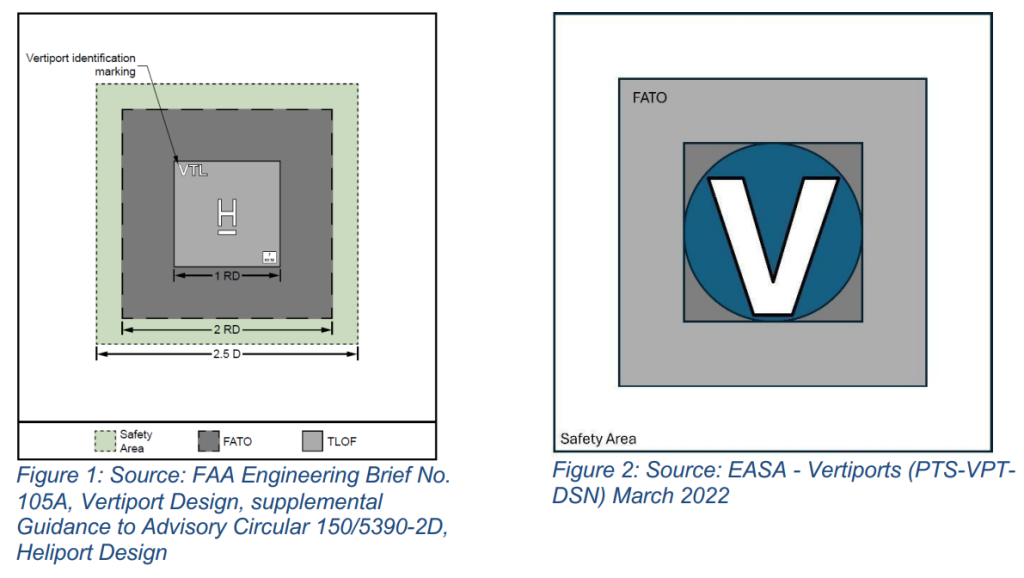
2.3.4. The lack of international standards for vertiport infrastructure can affect air traffic safety and efficiency. Although most physical requirements—such as those for safety areas, FATOs, and TLOFs — are similar, the possible differences in regulations mean that ATCOs must manually coordinate operations for both helicopters and eVTOLs using the same spaces. These variations also create visual inconsistencies, making navigation more challenging for pilots and requiring ATCOs to give more detailed instructions to avoid errors. As a result, ATCOs may have to constantly compensate for mismatched safety protocols, which raises the risk of mistakes due to the absence of unified regulations.
2.4. Wake Turbulence Comparison: Fixed Wing vs Helicopter vs eVTOL
2.4.1. In certain circumstances, ATCOs are responsible for wake to prevent incidents from vortices, which pilots cannot see. ATCOs ensure safety by applying set time or distance minima based on wake turbulence policies.
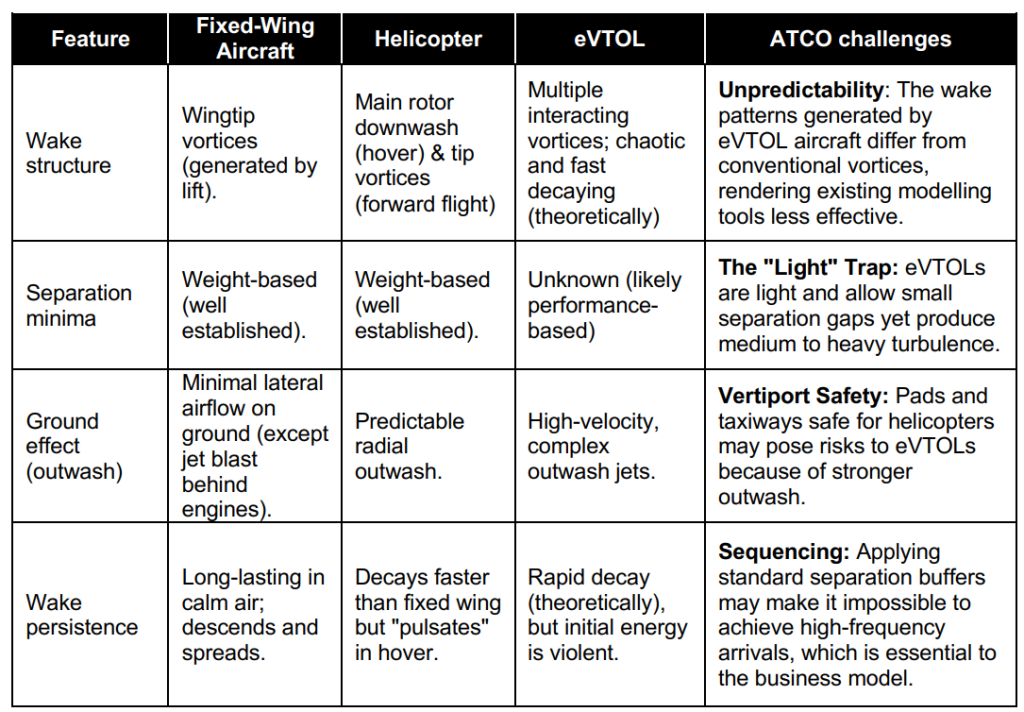
2.4.2. The primary challenge for ATCOs arising from eVTOL wake turbulence minima is the requirement to address unpredictable hazards with procedural standards that may not adequately reflect current operational realities. Existing fixed, weight-based separation resulting in the application of conservative, expanded separation minima that impede the “no-delay” objective desired by AAM operations.
2.4.3. The wake turbulence generated by various aircraft types presents unique challenges for ATM.
- Fixed-wing aircraft: Creates predictable, stable, counter-rotating wingtip vortices, with intensity primarily determined by weight and wingspan, allowing for well-established separation standards.
- Helicopters: Generates a more concentrated, coherent downwash in hover, and shed intense vortices in forward flight, requiring caution during ground operations.
- eVTOLs: Utilizing distributed electric propulsion (DEP)1 (TYTO ROBOTICS, 2025) [5.4], eVTOLs rely on multiple smaller rotors that must move air very fast to support the aircraft weight.
2.4.4. As eVTOLs with their specific wake turbulence characteristics are introduced there may need to be policies developed for their handling. The following table highlights the ATCOs challenges and safety gaps when applying the standard “fixed wing” or “helicopter” separation standards to eVTOLs.
2.5. Vertiports integration into Aerodrome – The challenges
2.5.1. Integrating vertiports into existing aerodromes may amplify the cognitive workload and operational challenges for ATCOs, primarily due to the stark performance discrepancies between traditional aircraft and UAM aircraft. ATCOs face the complex mental geometry of coordinating fast legacy jets (150–250 knots) simultaneously with significantly slower eVTOLs (60–120 knots). This difficulty is compounded by the eVTOLs’ vulnerability to heavy aircraft wake turbulence, forcing ATCOs to constantly monitor and apply prescribed protective spacing.
2.5.2. To maintain overall efficiency and safety, airport operators may design separate, dedicated routes for eVTOLs to ensure they are not sequenced onto the same final approach as large commercial traffic. Additionally, Very Low Level (VLL) operations have been created to remain below the levels utilised by conventional aviation during their cruising phase. However, there could be workload implications if the transition zones of these airspaces intersect. Even with newly designed UAM routes, specialized terminal procedures, and localized Letters of Agreement intended to structurally deconflict the airspace, ATCOs must actively manage and enforce these boundaries. Design elements to prevent departing eVTOLs from crossing conventional approaches, missed approaches, or established helicopter paths should be considered. While these procedural tools and separate routes are necessary, the ultimate burden of monitoring these simultaneous traffic flows falls squarely on the controller.
“The safe integration of these aircraft and operations into the airspace creates a challenge in terms of complexity and capacity limitations.”
– Giancarlo Ferrara, Drone/U-space R&D Work Programme Manager at EUROCONTROL [5.5]
2.5.3. This complex spatial management is further complicated by the small, quiet design of eVTOLs, which can make them difficult to spot visually. Visibility will vary by airport; while vertiports located near the aerodrome control tower will offer clear sightlines, obstructed locations will force ATCOs to rely on digital surveillance, which is vulnerable to signal blockages and ground-level blind spots. Ultimately, because many of these operational details remain speculative, mitigating these risks will require site-specific evaluations rather than universally applied assumptions.
2.5.4. The operational strain of this integration was quantified by the German Aerospace Centre (DLR) in their “HorizonUAM” (HorizonUAM, 2024) [5.6] study, which simulated vertiport operations at a busy Hamburg Airport. In scenarios combining standard commercial traffic with high-intensity air taxi movements, seasoned ATCOs experienced a 44% increase in perceived workload and an 18% reduction in situational awareness. Despite the use of upgraded display systems that highlighted UAM routes and real-time hazard data, the study confirmed that managing these concurrent flows pushes human capacity to its limits. The simulation underscored that while technically feasible in isolation, the cognitive burden of mixing these traffic types within the same aerodrome control zone is unsustainable without significant mitigation, pointing to an imperative need for full structural separation between traditional and UAM flows.
2.5.5. Current ATC systems are optimized for the predictable, linear flows of large commercial aircraft, relying heavily on sector divisions and standardized communication to manage human workload. The establishment of on-airport vertiports could present new operational challenges that existing legacy systems were not initially structured to address but must ultimately integrate. Initial operations are expected to be conducted under VFR (Visual Flight Rules). IFR operations will likely follow as integration, certification, and procedural frameworks mature. Although, this integration ensures strict regulatory compliance, it may introduce scalability bottlenecks as traffic volumes surge within the aerodrome environment. Furthermore, the necessity for immediate tactical interventions—such as rerouting around weather or conflicting traffic—presents challenges that current automation may not fully resolve. Consequently, it is essential for ATCOs to remain actively involved. By preserving their situational awareness and expertise, controllers continue to serve as the critical human fallback, safeguarding operations during nonnominal events or system degradations.
2.5.6. Furthermore, it is recommended that the definition for AAM reflect the one provided by the ICAO AAM Study Group (SG) as follows:
“A transformative vision for the future of aviation, focusing on the integration of innovative aviation technologies into daily life, with the goal of offering new services, enhancing mobility, service delivery, and contributing to a more sustainable transportation system.”
Conclusion
3.1. The introduction of eVTOL aircraft and vertiports within existing airport infrastructures presents unique considerations for the established ATM framework. These considerations largely arise from the need to balance capacity while accommodating aircraft with distinctly different performance profiles. Because current ATM systems are highly optimized for the structured, sequential flow of conventional aircraft, thoughtful adaptations will be required to harmonize this traffic with the rapid, energysensitive operational cycles of battery-powered eVTOLs. Additionally, the distinct wake turbulence and unconventional flight profiles associated with Distributed Electric Propulsion (DEP) aircraft will require careful management to ensure smooth and safe co-existence with traditional operations, particularly in shared runway environments. Within the IFATCA TPM there is currently no specific policy for vertiports. Thus, it is recommended to adopt a provisional policy to support the introduction and utilisation of vertiports within the ATM framework.
3.2. Driven by the rising demand for airport shuttle services and the industry’s push for rapid certification, maintaining rigorous safety standards remains paramount. IFATCA’s position should be that a highly effective methodology to achieve this is strategic integration, which involves establishing dedicated take-off and landing zones independent of standard runways and their associated approach and departure surfaces. Implementing such physical deconfliction facilitates the management of high-density traffic, ensures VTOL flight trajectories remain strictly separated from traditional commercial approaches, and prevents new mobility services from overloading ATCOs.
3.3. Enhancements in automation may be necessary to support the long-term vision of high-density operations. However, implementation must follow a deliberate and methodical approach that preserves human oversight and operational control as the foundation of safety. By maintaining active ATC involvement, the system can leverage ATCOs critical expertise to mitigate risk and provide the flexibility necessary to allow for sustainable scalability while preserving safety and efficiency for all system users.
3.4. To establish a standardized vocabulary and ensure a common understanding as these operational concepts are integrated into ATM, it is recommended that the TPM manual be updated to include formal definitions for VTOL, vertiport, and AAM, as these terms are currently absent from the document. Specifically, the definitions for VTOL and vertiport should be adopted as defined in Paragraph 1.1 above in the introduction.
Recommendations
4.1. It is recommended to include the following as Acronyms and Definitions to the TPM:
Vertiport: An area of land, water or structure that is used or intended to be used for landing, take-off and movement of VTOL-capable aircraft.
Vertical Take-Off and Landing (VTOL): A power-driven, heavier-than-air aircraft, other than aeroplane or rotorcraft, capable of performing vertical take-off and landing by means of lift and thrust units used to provide lift during take-off and landing.
Advanced Air Mobility (AAM): A transformative vision for the future of aviation, focusing on the integration of innovative aviation technologies into daily life, with the goal of offering new services, enhancing mobility, service delivery, and contributing to a more sustainable transportation system
4.1.1. IFATCA’s provisional policy on Vertiports be included in the TPM:
| Vertiports – Provisional Policy |
| IFATCA Policy is: IFATCA supports the strategic integration of vertiports which includes: ○ Active involvement from ATCOs to ensure operational feasibility ○ Consider proximity to existing runways, helipads, and their arrival and departure paths, to minimize operational impacts and promote safety and efficiency ○ Ensure wake turbulence effects are taken into consideration |
References
5.1. EASA – Vertiports (PTS-VPT-DSN), March 2022
5.2. EASA – COMMISSION IMPLEMENTING REGULATION (EU) 2024/1111, Retrieved from https://eur-lex.europa.eu/legal-content/EN/TXT/PDF/?uri=OJ:L_202401111
5.3. Schweiger, K.; Preis, L. (2022), Urban Air Mobility: Systematic Review of Scientific Publications and Regulations for Vertiport Design and Operations, MDPI (drones), Retrieved from https://www.mdpi.com/2504-446X/6/7/179
5.4. Lauren Nagel, Distributed Electric Propulsion (DEP) 2025, TYTO ROBOTICS, Jan 02 2025, Retrieved from https://www.tytorobotics.com
5.5. Gonzalo Velasco (2025), Getting ready for take-off: Understanding vertiports and AAM infrastructure, Steer, Retrieved from https://steergroup.com/insights/news/getting-ready-take-understanding-vertiportsaam-infrastructure
5.6. HorizonUAM – The Future of Urban Air Mobility (A research project of the German Aerospace Centre (DLR) (2024), Retrieved from https://www.dlr.de/en/fl/media/publications/brochures/2024/2024-the-future-ofurban-air-mobility-dlr-broschure.pdf/@@download/file
Abbreviations
| AAM | Advanced Air Mobility |
| ATCO | Air Traffic Controllers |
| ATM | Air Traffic Management |
| DEP | Distributed Electric Propulsion |
| EASA | European Union Aviation Safety Agency |
| eVTOL | electrical Vertical Take Off Landing |
| FAA | Federal Aviation Administration |
| FATO | Final Approach and Take-Off |
| IFR | Instrument Flight Rules |
| SA | Situational Awareness |
| TBO | Trajectory Based Operations |
| TLOF | Touchdown and Lift-Off |
| UAM | Urban Air Mobility |
| UAS | Uncrewed Aerial Systems |
| UTM | Unmanned Aircraft System Traffic Management |
| VFR | Visual Flight Rules |
| VTOL | Vertical Take Off Landing |


